


Cover photo of courtesy of Athletics Australia
With one selection criteria being entirely discretionary and referencing Commonwealth Top List performances, and the other cut-throat qualifying based largely on World Rankings, could it be that some athletes selected in the World Championships will miss a spot for the Commonwealth Games?
First things first: the Australian Commonwealth Games team is constrained to 68 able bodied athletes, due to a quota set by Commonwealth Games Australia. This will mean a much smaller team than the 107 selected for the Gold Coast in 2018 or the 99 selected for Glasgow in 2014.
Commonwealth Games selections are entirely discretionary for each country, without qualifying standards to meet. Athletics Australia has set a nominations policy that will see six development athletes selected, along with automatic nominations for athletes who had met the World Championships qualifying standard by the time they had won nationals.
On the other hand, the World Championships have a very objective, but highly convoluted, qualification pathway: meet a performance qualifying standard (the very objective part), or otherwise be the next best ranked athletes based on World Athletics Rankings (the convoluted bit). Australia can enter up to 3 athletes per event, without any limitation to the overall size of the team. At the last World Championships in 2019, Australia had a team of 60 athletes. 
The selection criteria for the two events read differently, with one of many considerations for the Commonwealth Games being the Commonwealth Top List since 1 June 2021 (presumably on a three-per-nation basis). These are tedious to create from World Athletics Top Lists (which are based on a calendar year), but for some context we’ve created a summary of these for the women’s track events, on a three-per-nation basis.
| Event | Top 3 | Top 8 | Top 16 | Top 3 Australians (in top 24) |
|---|---|---|---|---|
| 100m | 10.76 | 10.94 | 11.11 | Hana Basic (18th), Ella Connolly (24th) |
| 200m | 21.81 | 22.33 | 22.70 | Riley Day (14th), Jacinta Beecher (16th), Ella Connolly (23rd) |
| 400m | 49.51 | 51.05 | 51.84 | Ella Connolly (24th) |
| 800m | 1:56.70 | 1:58.90 | 2:00.70 | Catriona Bisset (11th), Georgia Griffith (16th), Imogen Barrett (17th) |
| 1500m | 3:58.30 | 4:02.10 | 4:11.40 | Jessica Hull (4th), Linden Hall (5th), Georgia Griffith (7th) |
| 5000m | 14:28.50 | 15:02.20 | 15:23.90 | Jessica Hull (10th), Natalie Rule (11th), Rose Davies (12th) |
| 10000m | 30:44.00 | 31:18.50 | 32:56.90 | Rose Davies (8th), Isobel Batt-Doyle (11th), Amelia Mazza-Downie (15th) |
| 100m H | 12.44 | 12.71 | 13.07 | Liz Clay (8th), Celeste Mucci (11th), Michelle Jenneke (13th) |
| 400m H | 54.09 | 55.48 | 56.72 | Sarah Carli (15th), Alanah Yukich (23rd), Isabella Guthrie (24th) |
| 3000m St | 9:01.50 | 9:28.70 | 9:47.90 | Amy Cashin (9th), Brielle Erbacher (11th), Cara Feain-Ryan (15th) |
Data presented on a three-per-nation basis, for the period 1 June 2021 to 10 June 2022.
There’s 42 individual events at the Commonwealth Games and four relays. With a maximum 68 athletes, that’s 1.6 athletes on average per individual event. To highlight some of the challenges with selection, that’s equivalent to selecting 16 athletes from the 10 events in the table above. Who do you pick? Who do you leave out? Want to pick a relay team including athletes not in individual events? Which places in other individual events do you sacrifice to do so? 
Add to all of that the fact that there is less depth in more technical events in the Commonwealth compared to track events (particularly in the field), and there could be selections and priorities that could surprise. Think the women’s Heptathlon – Oceania Champion Tanielle Crase is ranked sixth in the Commonwealth in the Heptathlon on a three-per-nation basis – and an outside chance at a medal dependent on who lines up in Birmingham and how the event unfolds. She’s higher ranked than some athletes who have already been selected, like Catriona Bisset, who is 11th in her event, the 800m.
Pre the recent Oceania Championships, Australia had 66 athletes within a qualifying position for the World Championships, so roughly the same size as can be picked for the Commonwealth Games. We’ll update that list next week, but it will stay roughly the same, or increase slightly due to the hyper-inflation that Oceania Championships results bring to World Rankings. 
In some events, there’s some noticeable differences between Top Lists and World Rankings, even within Australia. Consider the women’s 800m. Oceania Champion Tess Kirsopp-Cole is the second ranked Australian for World Championship selection (she was ranked 37th for a field of 48 prior to Oceania Championships, and now listed as 27th because World Athletics treats the Area Champion as having qualified. But even without that, she’ll have enough points to remain in the top 48 at the end of qualifying in 16 days time). However, she’s not ranked in the Top 5 Australians on the Commonwealth Top Lists (based on fastest times since 1 June last year), with the third ranked Australian (Imogen Barrett) being ranked 17th in the Commonwealth on a 3-per-nation basis. If you took Barrett out of consideration and put Kirsopp-Cole into the rankings, she’d sit around 21st in the Commonwealth.
With only 68 athletes being able to be selected for Commonwealth Games, does an athlete ranked 21st in their event in the Commonwealth get a spot? Or does Kirsopp-Cole get selected for the World Championships, but not for the Commonwealth Games?
The point of this discussion isn’t to single out Tess Kirsopp-Cole – she’s performed really well in her first season stepping up to the 800m – and in our view, deserves to wear the green & gold. The question is, at what championship(s)? And there’s countless other selection dilemmas that will be faced in the coming weeks for Athletics Australia’s selectors, and some interesting outcomes to be sure.
Who are your picks for the Commonwealth Games? Join the discussion on our Facebook page.
[wcepe_products ids=’297,306′ columns=’2′]
Latest posts:
- Chasing Fear | An UNSCENE Short Film on Olympic Gold Medalist Nina Kennedy
 This film from the team at UNSCENE tells Nina’s story post the injury that took her out of the World Champs. Nina gives us an insight on the mundanity of rehabilitation post-injury, and the discipline it takes to return in a better place. Nina also talks about her relationship with fear, taking us inside the… Read more: Chasing Fear | An UNSCENE Short Film on Olympic Gold Medalist Nina Kennedy
 - Robinson joins Ron Clarke in the record books with Oslo 5000m run
 Ky Robinson has become the first Australian male since the great Ron Clarke to simultaneously hold the national records over both 5000m and 10,000m, after slicing almost five seconds off Craig Mottram’s long-standing 5000m mark at the Oslo Diamond League — the Bislett Games — overnight. Robinson finished eighth in a blisteringly fast field in… Read more: Robinson joins Ron Clarke in the record books with Oslo 5000m run
 - The 63-spot squeeze: Inside Australian Athletics’ Toughest Selection Calls
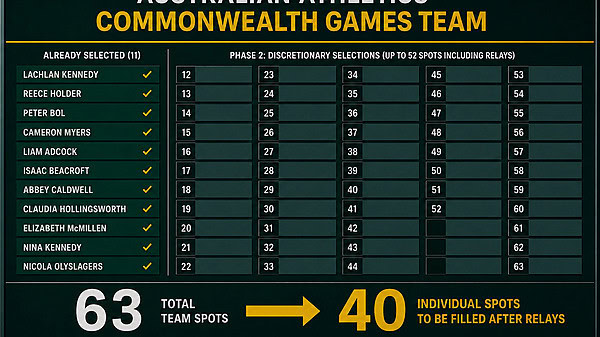
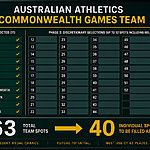 With the qualifying period over and 11 athletes already locked in through automatic nomination, and with all three relay teams qualified, Australian Athletics selectors now turn to the hard part: filling out a Commonwealth Games team capped at 63 able-bodied athletes. The automatic phase rewarded the clearest-cut cases: athletes who hit the Automatic Nomination Standard,… Read more: The 63-spot squeeze: Inside Australian Athletics’ Toughest Selection Calls
 - Australian Top Lists
 Check out the top 8 performances by Australian athletes in the lead up to Commonwealth Games selection. With Top Lists back in vogue in the selection policy for Glasgow’s Commonwealth Games and for Oceania Championships selection (compared to prior years for World Athletics events where World Rankings ruled), here’s the performances that selectors will be… Read more: Australian Top Lists
 - Strintzos, Batt-Doyle clock fastest half marathons on home soil
 The Launceston Running Festival continued its tradition of providing a platform for fast times for some of Australia’s top distance runners, with Haftu Strintzos and Izzi Batt-Doyle recording the fastest half marathons run by Australian on home soil. Strintzos’s 60:41 winning time – an Australian Allcomers Record – was just five seconds shy of his… Read more: Strintzos, Batt-Doyle clock fastest half marathons on home soil