

With the qualifying period over and 11 athletes already locked in through automatic nomination, and with all three relay teams qualified, Australian Athletics selectors now turn to the hard part: filling out a Commonwealth Games team capped at 63 able-bodied athletes. The automatic phase rewarded the clearest-cut cases: athletes who hit the Automatic Nomination Standard, won their national title, and showed up to the domestic season. Everyone else falls into Phase 2, where discretion reigns and the easy answers run out.
Table of Contents
The brief selectors are working to is deliberately ambitious. The policy’s stated aim is to send athletes with the realistic potential to win a medal or finish top eight, and relay teams capable of a top-four finish. It also asks selectors to look beyond Glasgow entirely, weighing each athlete’s potential to contribute at future World Championships and the 2028 and 2032 Olympics. In other words, a 63-spot team has to balance present medal chances against longer-term investment.
Crucially, there are no entry standards that must be met in Phase 2. The Automatic Nomination Standard — the qualifying marks published for each event — mattered for the earlier automatic phase, but for discretionary picks it is explicitly downgraded to “a consideration only.”
Instead of a single benchmark, selectors weigh a list of factors with no defined priority order. These include where an athlete sits in the Commonwealth Rankings — drawn from World Athletics Top Lists, with the unhelpful wrinkle that those lists don’t separate the home nations from Great Britain — and how close that ranking puts them to a medal. They also include previous performances at major championships, repeat results at or near the standard, the national championship result, commitment across the Summer Series, current form and fitness, potential for improvement, and likelihood of significant future improvement toward 2028 and 2032. Times, distances and heights count, but the policy is emphatic that raw marks are not the only thing: the ability to deliver in championship-style settings and the genuine likelihood of medal success carry weight.
Already selected athletes – Phase 1
| Name | Event |
| Lachlan Kennedy | 100m |
| Reece Holder | 400m |
| Peter Bol | 800m |
| Cameron Myers | 1500m |
| Liam Adcock | Long Jump |
| Isaac Beacroft | 10000m Walk |
| Abbey Caldwell | 800m |
| Claudia Hollingsworth | Mile |
| Elizabeth McMillen | 10000m Walk |
| Nina Kennedy | Pole Vault |
| Nicola Olyslagers | High Jump |
This is where the team’s overall shape comes into play. Because the quota is fixed at 63, every discretionary nomination effectively contributes to a decision not to pick someone else. The policy makes the trade-off explicit by tying discretion to producing “the highest overall results” for the team as a whole, not to rewarding every athlete who clears a notional bar. Relay considerations sharpen this further: a relay squad member judged a medal chance can be nominated ahead of an individual athlete chasing a spot, and earlier being part of a qualifying relay team confers no automatic status either way.
The result is a selection problem with real tension built into it. An athlete ranked just outside medal contention in a weak event in the Commonwealth (generally, throws, walks and multi-events) may present a better medal prospect at the Games than the a world class performer in a strong Commonwealth event (sprints, middle distance). Yet the stronger event’s athlete might offer more for 2028 and beyond. Selectors are asked to hold all of it at once: ranking, medal proximity, championship temperament, domestic-season commitment, future trajectory, and the best overall use of 63 places.
63 places is really now only 40
With 11 athletes already named and three relay teams to be chosen following World Relay Championships placings, there are realistically only around 40 positions available for non-relay athletes. Expect four additional runners named in the men’s 4x100m to join Lachlan Kennedy (already selected in the 100m), a squad of up to five for the women’s 4x100m, and at least three runners added for the mixed 4x400m, joining Reece Holder (already selected in the men’s 400m). Because 400m hurdlers are routinely drafted into Commonwealth Games 4x400m squads given the team sizes involved, there’s likely no need for dedicated reserves beyond the specialist 400m runners selected.
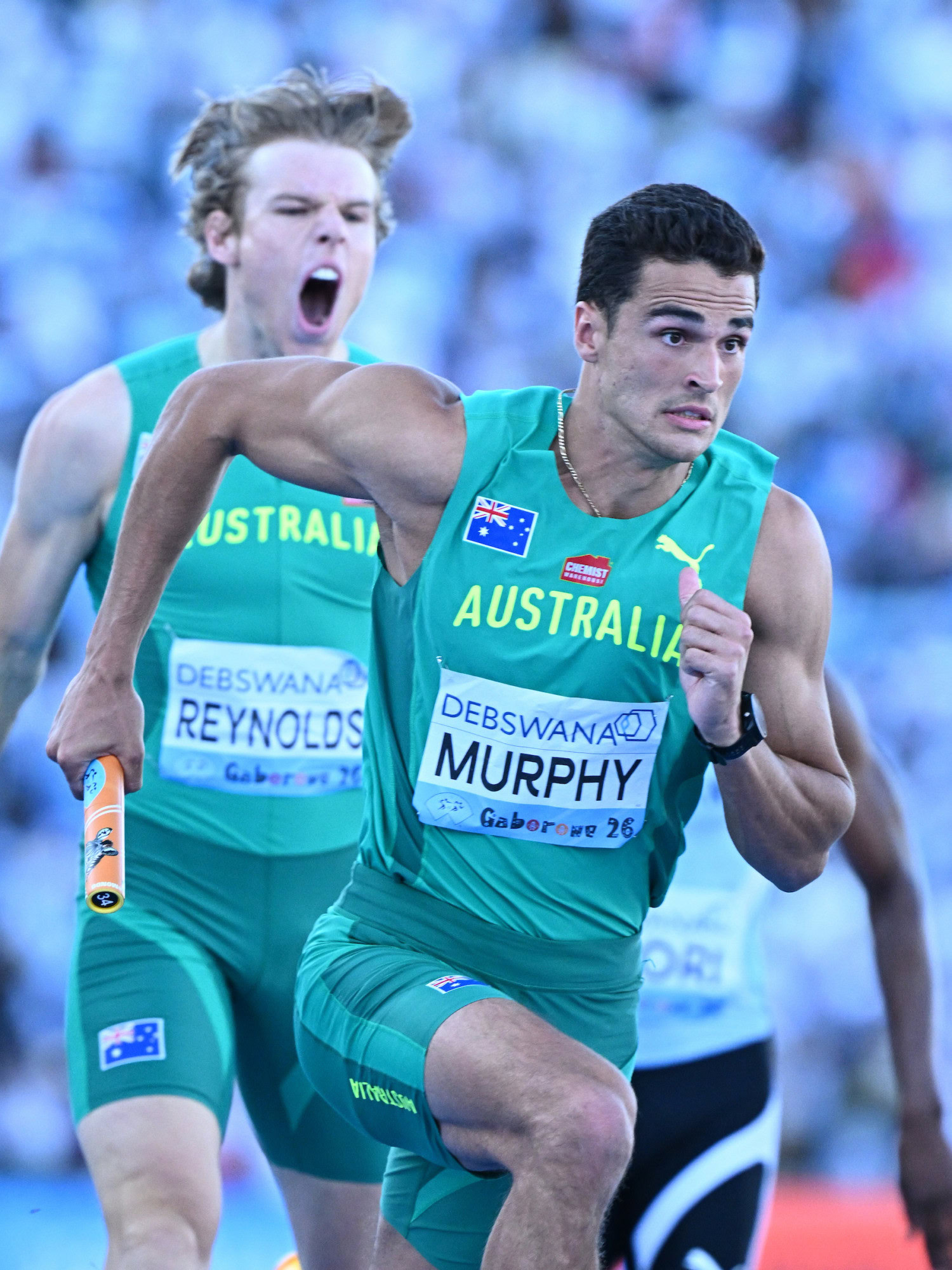
Some relay runners will also be named in individual events. One would expect Aidan Murphy, for instance, to line up in both the 200m and the 4x400m. Even so, once the relay obligations are accounted for, at most 40 spots remain for athletes selected on individual merit. Some will be easier than others to decide – for example, Matt Denny in the discus and Jess Hull in the mile – but for the final 10 or 15 places, every one of those is a genuine either/or.
Women’s distance program: designed for doubles
Unlike the men’s program — where contesting the 800m/1500m or 1500m/5000m double is impractical, with all three finals held in the final evening session — the women’s schedule permits, even encourages, doubling. That single scheduling opportunity reshapes the entire selection calculus, because a doubling athlete can deliver two medal chances from one of those 40 places.
Women’s Middle Distance/Distance Timetable
| 800m | Mile | 5000m | 10000m | |
| Day 1 Morning | ||||
| Day 1 Evening | Heat | Final | ||
| Day 2 Morning | ||||
| Day 2 Evening | ||||
| Day 3 Morning | ||||
| Day 3 Evening | Semi | |||
| Day 4 Morning | Heat | |||
| Day 4 Evening | Final | |||
| Day 5 Morning | ||||
| Day 5 Evening | Final | |||
| Day 6 Morning | ||||
| Day 6 Evening | Final |
There are multiple Australian athletes who have the ability to double:
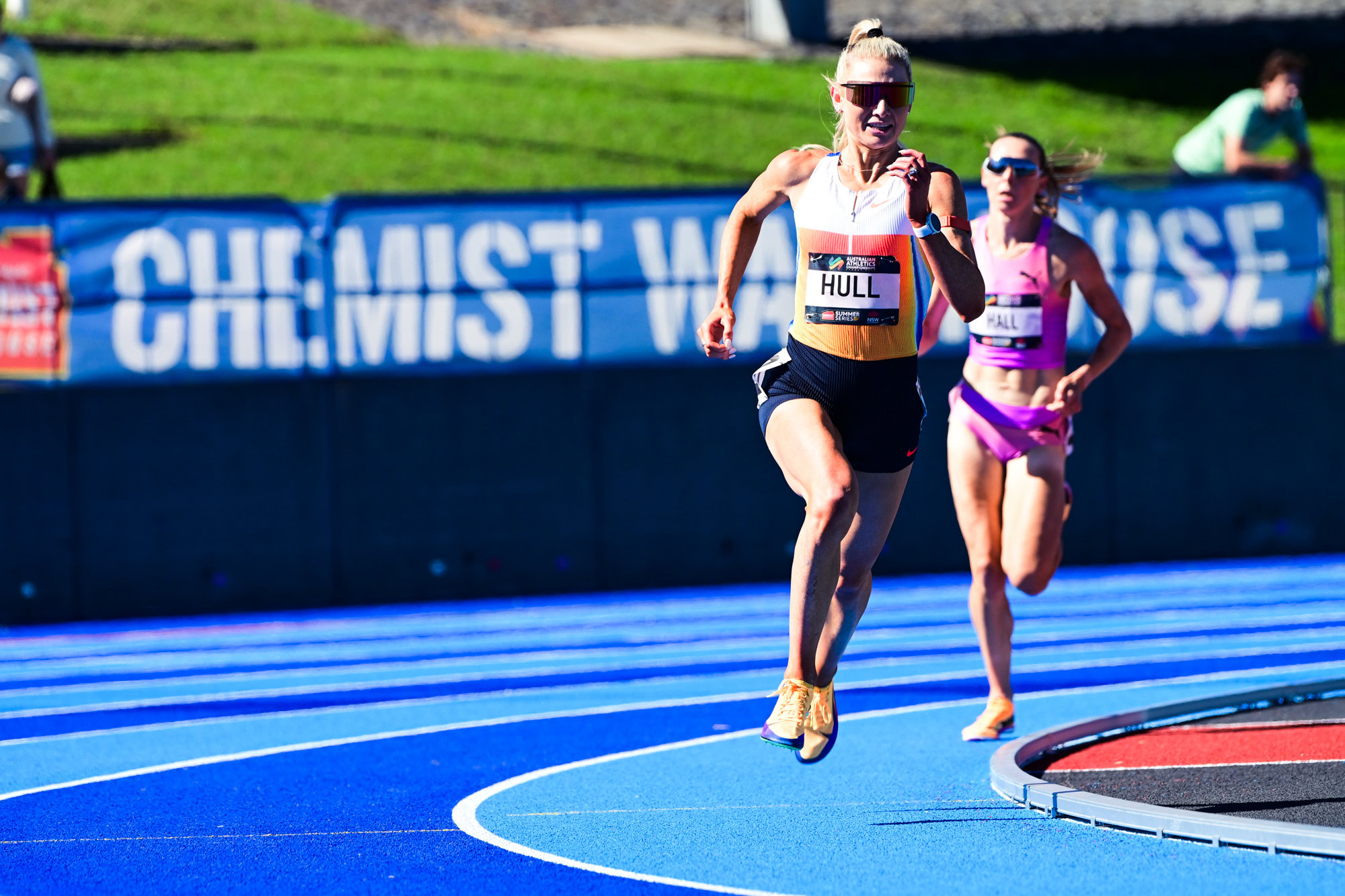
Jess Hull across any of 800m/1500m/5000m. Has publicly indicated 1500m/5000m aim for Commonwealth Games. Australian record holder in 800m and 1500m. Doubled, winning medals in both, over 1500m/3000m at World Indoors. Despite current form not being at her peak, Jess is a proven performer across all distances on the global stage.
Abbey Caldwell: 800m/Mile. Already selected in 800m but having just moved to #2 Australian all-time in the 1500m and winning the Xiamen Diamond League. Has publicly indicated 1500m (Mile at Commonwealth Games) as her likely future and desires to double whenever she can.
Claudia Hollingsworth: 800m/Mile. Already selected in the Mile and with an 1:57.67 PB from last year, 1:58.91 this year, and 2nd at nationals in the event.
Sarah Billings: 800m/Mile. Not yet selected in any event but moved to #2 Australian all-time in the 800m on the final day of qualifying with a 1:57.61. 2nd at Nationals in 1500m, 3rd in 800m.
Linden Hall: Mile/5000m. Not yet selected in any event and was second at nationals over 5000m (did not contest 1500m). A proven performer and World Championship finalist last year over 5000m.
Rose Davies: 5000m/10000m. Only 4th at Nationals over 5000m but a World Championship finalist, Australian record holder and fastest in the qualifying period. Australian record holder and ranked 4th in the Commonwealth over 10000m during the longer qualifying period provided for that event in the Nomination Criteria.
Lauren Ryan: 5000m/10000m. 5th at Nationals over 5000m but second fastest during the qualifying period and ranked 8th in the Commonwealth, and Australian Champion over 10000m where she is also ranked 8th. Would have been automatically selected in the longer event had she contested the 3000m at the Maurie Plant meet, having recorded the 10000m qualifying standard back in March 2025 during the longer period allowed for that event under the Nomination Criteria and winning the national title at Zatopek in December, but not ticking the box of competing in a Summer Series Meet.
In addition there are other quality performers such as Hayley Kitching (21, World Indoor finalist, ran a 1:59.15 PB on the weekend), Maudie Skyring (14:49.93 PB, 15:03.81 in qualifying period, third at nationals) and Izzi Batt-Doyle (10000m last year in 30:51.27 to rank 7th in the Commonwealth) who have strong claims during the qualifying period in single events. 2025 World Indoor 1500m bronze medallist, Georgia Griffith, is one of 6 women to break 2 minutes for 800m during the qualifying period, but only gets a footnote mention without performances of note in the 1500m or 5000m, demonstrating the quality of competition to make the team.
Within the constraints of the remaining selections, doubling offers the most leverage for the overall team. A single nomination that yields two starts in medal-capable events is, in pure quota terms, worth more than two separate individual picks — which is precisely the “highest overall results” logic the policy demands. However, a single-event specialist with a genuine medal shot might still outrank a doubler’s weaker second event.
Comparing apples and oranges
This is where the criteria bite hardest: how do you weigh an 800m runner against a shot putter or a heptathlete? The only comparable objective scale is their Commonwealth Ranking. A ranking of 10th in a deep Commonwealth 800m field may represent a currently better athlete on the global stage, and arguably a comparable medal prospect, than a national champion sitting outside the top ten in a thinner event, or vice versa.
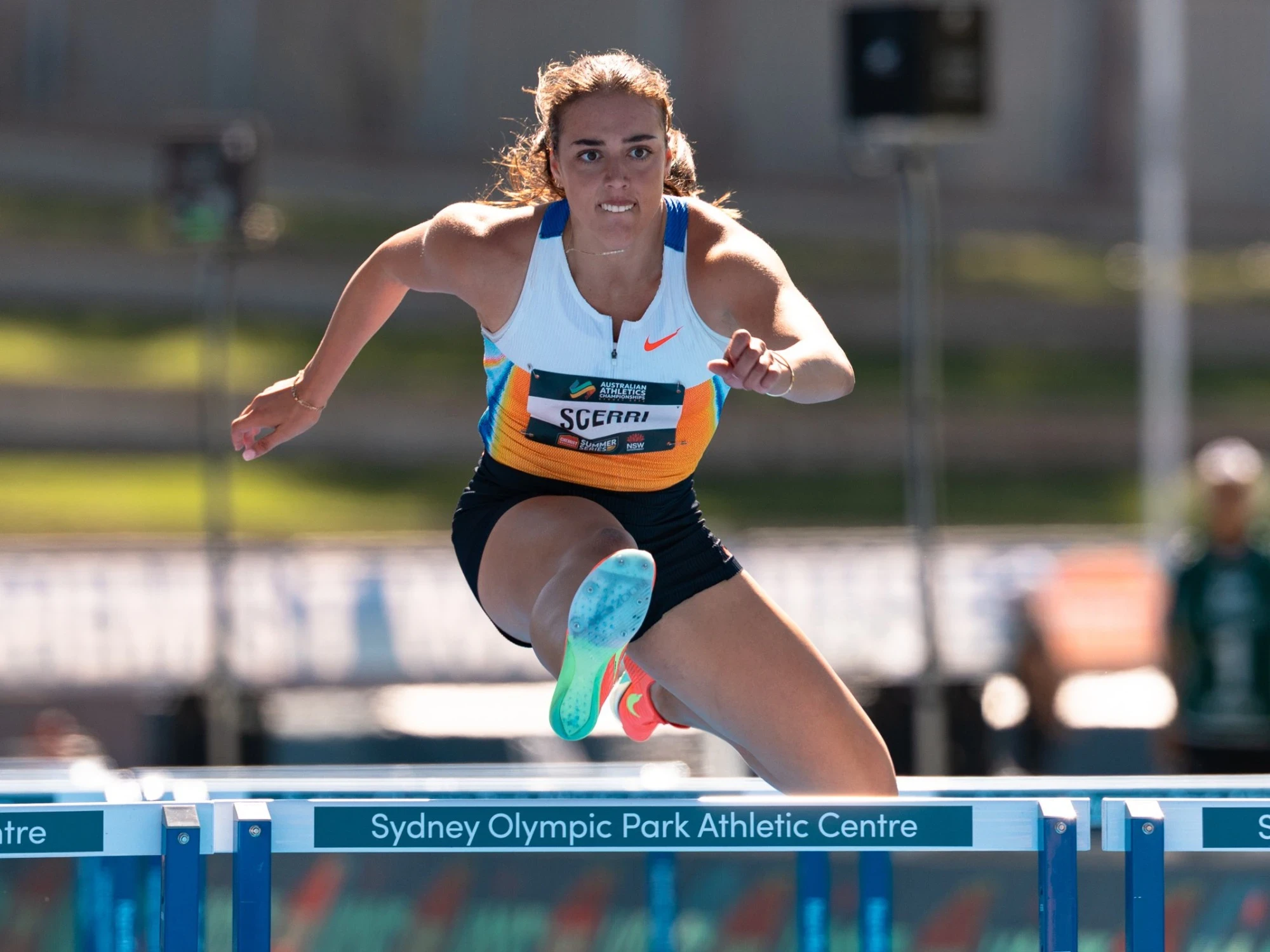
For argument’s sake, accept the premise that Sarah Billings should take one of the two remaining 800m spots, all other things being equal and unconstrained. How does that stack up against other events? Billings ranks 10th in the Commonwealth in her event, on roughly equal billing with Marley Raikiwasa (20 years of age, with a breakthrough 17.57m PB last weekend, #4 Australian all-time in the shot put, 9th in the Commonwealth top lists), and below all of the top three of Australia’s heptathletes (4th, 5th and 8th in Commonwealth top lists). If it comes down to a single remaining place, who do you choose? There is no formula in the policy that answers that question. The factors are listed; their weighting is not. That is the discretion, and it is also the exposure.
Challenges to nomination decisions
Like the Olympic Games, Australian Athletics doesn’t actually select the Commonwealth Games team. Nominations are made by Australian Athletics; the formal selection is made by Commonwealth Games Australia, which receives those nominations. Selections generally won’t be announced until the appeal windows have closed.
So what happens in an appeal? A non-selected athlete first requests from Australian Athletics the reasons for their non-selection, which must be provided in writing. With the full reasoning in hand, the athlete can make an informed decision about whether to lodge a formal appeal, heard independently by the National Sports Tribunal.
The Weightman case from the 2024 Olympic cycle is both a cautionary precedent and directive on expectations. The NST upheld Lisa Weightman’s appeal, finding the nomination criteria had not been properly applied, but its power was limited to referring the decision back to Athletics Australia rather than substituting its own. The original selection committee reconsidered and re-affirmed its decision. The lesson is clear: an athlete can ‘win’ the appeal and still not ultimately make the team. But perhaps more importantly in assisting athletes during what is a rarefied and timebound environment full of emotion, the Weightman case provided a clear principle for transparent communication to affected athletes:
“In order to understand why they were not nominated, a non-nominated athlete is entitled to be told what matters were taken into account, how those considerations were applied or, to put it another way, why the application of those matters resulted in their non-nomination. Considerable discretion is given to selection committees, who are experts in the relevant sporting activity, and experienced in the selection of athletes and the factors relevant to performance at elite level competitions. Reasons do not need to be tens of pages in length. A page or two may suffice.“
This matters enormously here because Commonwealth Games selection is a zero-sum game, not just within any single event, but within the entire team. Any athlete potentially affected by a selection decision has the right to be involved in the appeal process; and, save for those already named, if a decision were changed following appeal it would necessarily mean displacing someone else. With only ~40 individual places after pre-selections and relays, and a thicket of doubling permutations behind them, the number of athletes with a plausible stake in any single contested spot is large. The permutations don’t just make selection hard; they make any appeal process genuinely difficult to manage for all involved, because unpicking one thread tugs at several others.
Waiting for the news
With 55 days remaining until the Games, the aspiring athletes wait to learn their fate. Before then, the selectors face the unenviable task of converting an ambitious, deliberately unweighted set of criteria into a finite list of names, and standing ready to justify, in writing, every place they did and didn’t award.