



Fast times in Brisbane, Perth and Sydney set up a scorching summer of sprinting, set to be headlined by world 100m champion Fred Kerley lining up at next month’s Maurie Plant Meet in Melbourne.
Kerley will line up in the Peter Norman Memorial 200m at the 23 February meet at Lakeside Stadium.
“I am excited to start my season in Australia and I will also use this as a training base for the upcoming season. I have competed in all the other continents, and I am excited to get the opportunity to compete in Australia,” Kerley said.
“Also, it is nice to open my season with the 200m because I got injured in the 200m semi-finals at the World Championships. All in all, I am excited to come and show my talent to the Australian people.”
Australia’s fastest 100m sprinter, Rohan Browning, will step in in distance for the Maurie Plant Meet, while World junior bronze medallist Calab Law is also set to feature. Law lowered his season leading 200m time with a 20.61 second (+1.0) run at the Norma Croker Shield meet at the Queensland Sport & Athletics Centre on Saturday. 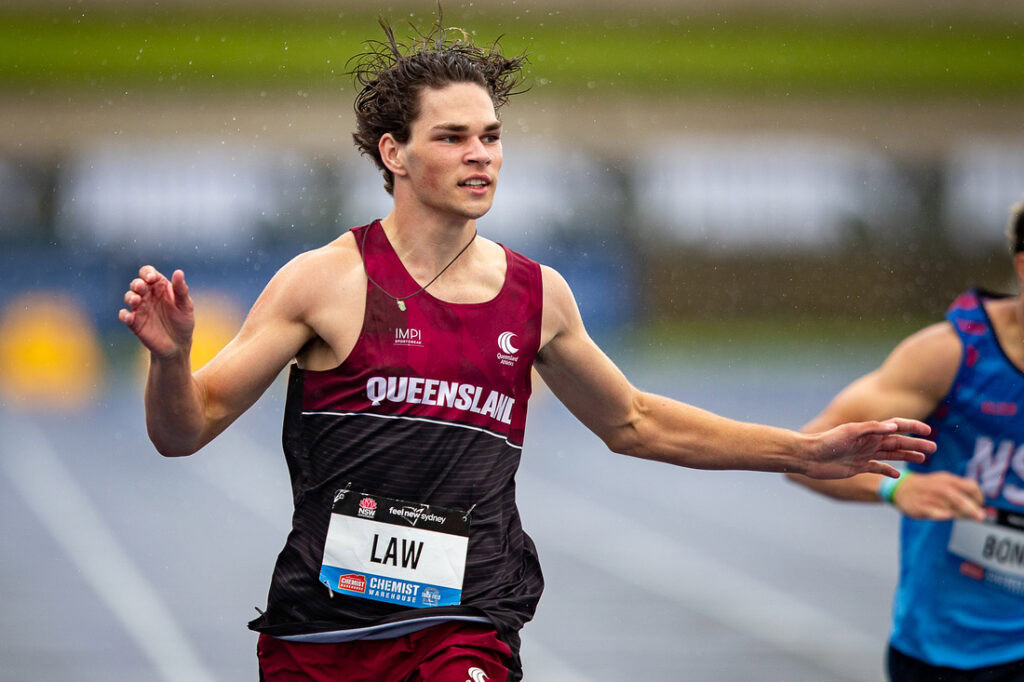
The 19-year-old Queenslander also leads the nation over 100m in his first season in the senior ranks, following a 10.26 second personal best back in November. That mark was equalled in Brisbane on the weekend by Anas Abu-Ganaba in a race in which Law finished third. Abu-Ganaba lowered his personal best of 10.28 seconds set back in 2018 in a dominant performance.
On the other side of the country, 31-year-old Brianna Beahan out dipped 16-year-old Olivia Dodds, with both recording the same time of 11.48 seconds into a 1.3 m/s headwind at the Strive Athletics meet at the freshly resurfaced WA Athletics Stadium. Beahan’s performance matched her 2021 personal best while Dodds slashed three-tenths-of-a-second off her PB set in January last year.
Michelle Jenneke also showed strong early season form with a 100m personal best of 11.63 seconds in Brisbane.
In Sydney at The Ridge, tailwinds affected all of the sprints, with quality competition taking place nonetheless. Australian Under 18 record holder Sebastian Sultana sped to a 10.20 second win (+2.7), edging out Commonwealth Games relay representative Jacob Despard (10.21). Jake Penny and Jackson Rowe (dead heat for third in 10.31), Joshua Azzopardi (10.33) and Christopher Ius (10.38) also recorded promising early season times.
Ius returned to the track to take victory in the 200m in 20.66 seconds (+3.2), ahead of Despard (20.72) and Rowe (20.76).
In the women’s sprints Monique Quirk took out a double in 11.35 (+3.1) and 23.70 (+2.4), with 2016 4x400m Olympian Jessica Thornton also recording a swift 100m of 11.59 seconds behind Quirk.
In the field Connor Murphy recorded a windy jump of 16.28m (+3.1).

Racewalking Supernova
At the AIS the Supernova 10000m walks were held over the weekend, with World Continental Tour Silver status. Jemima Montag (43:35.74) and Declan Tingay (39:23.98) took out the races.
Non-sanctioned meets
World Athletics has implemented a new sanctioning process for meets from 1 January, with not all Australian deomsstic meets having the World Rankings Competition classification required for performances to count towards World Athletics Top Lists and World Rankings (those that do are listed on the World Athletics calendar). All of the performances noted above were performed in World Rankings Competitions. Some otherwise noteworthy performances were recorded in non-World Rankings Competitions over the weekend (and thus won’t feature on top lists etc):
- Jack Hale running 10.30 seconds (+1.5) in Hobart
- Jessica Stenson (15:46.11) and Ellie Pashley (15:54.77) tuning up for the World Cross Country Trials with performance in a mixed 5000m race in Geelong.
[wcepe_products ids=’399,313,668′ columns=’3′]
Latest Posts:
- The puzzle is complete: Strong Australian team set for Glasgow
 Five Commonwealth Games champions from Birmingham return in the 63-strong open Australian team for the Glasgow Commonwealth Games along with 23 athletes in para events. The gold medallist journeys have all been different, with career highs and injuries occurring since their last Commonwealth Games. Matt Denny enters with the longest throw in the world so… Read more: The puzzle is complete: Strong Australian team set for Glasgow
 - Eleven criteria and one difficult choice: what the Azzopardi selection tells us about discretion in Australian athletics
 Every season it arrives on schedule. A team is named, an appeal follows, supporters take sides, and then the argument stops being about one athlete and becomes about the system. This year it is Josh Azzopardi. And the reason it has landed is simple. The athlete he beat at nationals, and ran faster than across… Read more: Eleven criteria and one difficult choice: what the Azzopardi selection tells us about discretion in Australian athletics
 - Chasing Fear | An UNSCENE Short Film on Olympic Gold Medalist Nina Kennedy
 This film from the team at UNSCENE tells Nina’s story post the injury that took her out of the World Champs. Nina gives us an insight on the mundanity of rehabilitation post-injury, and the discipline it takes to return in a better place. Nina also talks about her relationship with fear, taking us inside the… Read more: Chasing Fear | An UNSCENE Short Film on Olympic Gold Medalist Nina Kennedy
 - Robinson joins Ron Clarke in the record books with Oslo 5000m run
 Ky Robinson has become the first Australian male since the great Ron Clarke to simultaneously hold the national records over both 5000m and 10,000m, after slicing almost five seconds off Craig Mottram’s long-standing 5000m mark at the Oslo Diamond League — the Bislett Games — overnight. Robinson finished eighth in a blisteringly fast field in… Read more: Robinson joins Ron Clarke in the record books with Oslo 5000m run
 - The 63-spot squeeze: Inside Australian Athletics’ Toughest Selection Calls
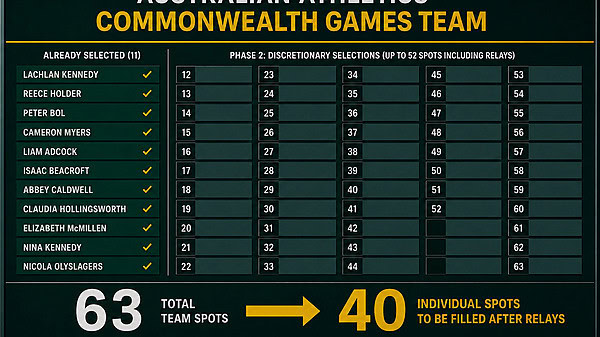
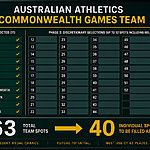 With the qualifying period over and 11 athletes already locked in through automatic nomination, and with all three relay teams qualified, Australian Athletics selectors now turn to the hard part: filling out a Commonwealth Games team capped at 63 able-bodied athletes. The automatic phase rewarded the clearest-cut cases: athletes who hit the Automatic Nomination Standard,… Read more: The 63-spot squeeze: Inside Australian Athletics’ Toughest Selection Calls