




The National Sports Tribunal dismissed all five appeals brought by athletes who missed individual selection for Australia’s Commonwealth Games team in Glasgow, with sprinter Josh Azzopardi, steeplechaser Ben Buckingham, hammer thrower Timothy Heyes, 400m hurdler Alanah Yukich and pole vaulter Dalton Di Medio all unsuccessful in their bids to overturn Australian Athletics’ decisions.
The five appeals were heard together over a single day on 15 June by a three-member panel of Anthony Nolan KC, Professor Jack Anderson and Jonathan Erbacher. Determinations dismissing each were published on 18 June.
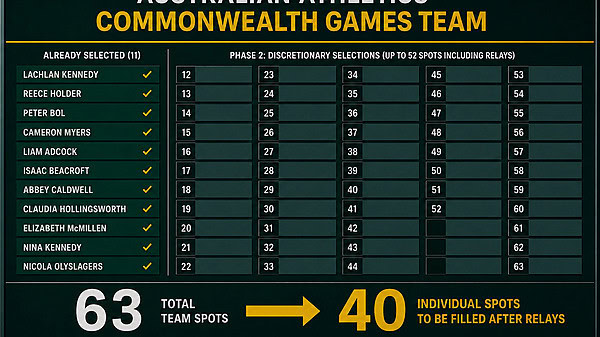
At the heart of every case sat the same problem: Commonwealth Games Australia were only able to allocate athletics 63 places. Once 11 individual athletes and 13 relay runners locked in automatic nominations, only 39 discretionary spots remained for the entire team, and the Tribunal repeatedly acknowledged that this left selectors making “difficult, marginal calls.” “All of the above leaves an athlete with a high bar to jump to successfully challenge a selection decision in the context of a matter where the Selection Committee has a broad discretion.“National Sports Tribunal
But the selectors had the law on their side. The 2026 nomination policy hands the Selection Committee an “absolute discretion”, guided by eleven factors it can weigh “in no defined order.” As the panel put it across all three reasoned determinations, that leaves “an athlete with a high bar to jump to successfully challenge a selection decision in the context of a matter where the Selection Committee has a broad discretion.” That bar isn’t unclearable — the panel was careful to note that selectors still can’t act “in an arbitrary or capricious way” and must take all relevant matters into account — but none of the five appellants got over it.
In each of the appeals the Tribunal held that Australian Athletics selectors “had in this instance acted in a principled way, aligned to the aims and objectives of the Policy, and that in a structured way they had considered all relevant matters and not mistaken material facts.“
How the team was chosen
The committee met twice. The first meeting, on 26 May, was a preliminary pass held before the qualifying period had even closed on 31 May, to work through the bulk of the team and map out the range of athletes in contention for the final places. Chair Peter Hamilton had asked each committee member for their preferred 63 athletes ahead of that meeting, compiled into a working spreadsheet that was updated as the discussion went. The second meeting, on 1 June, was where the committee reached its final consensus on who would be nominated. Athletes were told of the outcomes on 3 June.
The headline case: Azzopardi v Browning
The most closely watched appeal in the media was Azzopardi’s. He’d beaten Rohan Browning at the national championships and run quicker across the qualifying period, yet Browning got the individual 100m berth. Both men were already on the team via the 4x100m relay, so this was a fight over an additional individual opportunity, not a seat on the plane.
The selectors didn’t dispute Azzopardi’s domestic credentials. Their reasoning, set out in Selection Chair Peter Hamilton’s affidavit, was that the two were closely matched but Browning had the higher ceiling: “At his best Mr Browning is the more likely to be successful and his progress during the 2026 season suggests that is possible.” The decision notice to Azzopardi was blunter, citing Browning’s “strong history of fast times and an overall head-2-head advantage over yourself.”
Article continues below
Azzopardi argued the panel had given undue weight to a single factor (Browning’s superior championship history) at the expense of the other ten criteria, where he claimed to be the stronger athlete. The Tribunal accepted that disproportionate weighting can amount to an unreasonable decision, but found the selectors had genuinely worked through a range of factors rather than fixating on one. As Browning himself put it in submissions (he’s a lawyer and represented himself), a decision isn’t unreasonable “simply because one conclusion has been preferred to another.”
Buckingham: a ranking error that didn’t matter

Buckingham’s case was the most interesting on the facts, because Australian Athletics got something wrong. The 3000m steeplechaser (also a lawyer, also self-represented) was told in his 3 June decision letter that his projected full-season Commonwealth ranking was “about 12 or 13.” But the Chair’s later affidavit conceded he actually sat at #8.
That’s a meaningful gap, and Buckingham argued it poisoned the whole assessment. The Tribunal agreed that if ranking had been the sole factor, the error might have been fatal to the decision. It wasn’t. The selectors had also weighed his current form; his international record; and, pointedly, the fact that neither he nor national champion Ed Trippas had recently produced times matching their best. The panel’s view was that even at #8 he was a possible top-eight finisher but no medal threat given “the gap to the top athletes.”
The Tribunal did note the conflicting communications about his ranking as a fair criticism of how the decision was relayed. But the substance held, and both grounds of appeal were dismissed.
Heyes: the late-career spike argument

Heyes, a 28-year-old hammer thrower, leaned on a different argument: that his data would have put him in the final at each of the last three Commonwealth Games, and that the selectors had wrongly written off his future. He’d thrown a lifetime best of 69.86m in 2026 after a three-year plateau, and pointed out that throwers typically mature technically into their early 30s.
The selectors saw the same plateau differently. Their reasoning told him plainly: “It is not about if you met the criteria or not, at the end it is discretion of the selectors on who they thought was most likely to be successful in 2026 and the future.” The Chair’s affidavit reframed the improvement question: not whether Heyes could improve, but whether he could improve enough to outpace younger Commonwealth rivals of similar ranking.
Yukich and Di Medio

400m hurdler Alanah Yukich and pole vaulter Dalton Di Medio rounded out the five, with both appeals likewise dismissed. The Tribunal’s full written reasons for their cases have not yet been published, so the detail of their specific arguments isn’t yet on the public record.
What the Tribunal told Australian Athletics
Across the reasoned determinations, the panel made the same closing points: they read as gentle but pointed advice rather than criticism.
First, on communication: when an athlete misses out, how they’re told matters. The Buckingham ranking mix-up is the obvious case study.
Second, on transparency: the panel praised the raw data, spreadsheets and affidavits Australian Athletics provided, but flagged that proper minute-taking of selection meetings would help “ensure complete transparency in the decision-making process not only for the purposes of that decision, but for the purposes of any appeal process.”
That point wasn’t new. The panel was quoting directly from Lauren Ryan v Australian Athletics, a case from September last year where Ryan unsuccessfully challenged her non-selection for the 5,000m at the Tokyo World Championships, a race for which Linden Hall, among others, was picked ahead of her. In that matter, the Tribunal was openly “concerned” to discover that no minutes had been taken of the relevant selection meeting at all, leaving it “entirely reliant” on the Chair’s affidavit. Nearly a year on, the panel evidently felt the point worth restating: repeating the Ryan transparency quote verbatim, even while noting the affidavits and data it did receive were helpful.
Third, a note for athletes: a supporting statement from a star coach carries limited weight if it’s only produced at the appeal. Get it in front of the selectors before the team is named is the tribunal’s advice.
The panel also went out of its way to praise the sportsmanship on display, noting the “palpable” mutual respect between athletes who’d been forced to compare themselves against teammates, and that legal disputes of this kind shouldn’t be read as undermining it.
The Full Appeals
The National Sport Tribunal decisions are: