

Jumping has always been part of Izobelle Louison-Roe’s life.
Long before podiums and qualifying standards, it was there in the backyard: sibling dares, improvised take-offs, and the kind of fearless experimentation that only kids seem to master. It followed her through gymnastics, where strength and movement were learned across every range, and later through athletics, where that instinct to rise found its most natural expression.
“When we were younger, me and my brothers were always jumping — off fridges, onto trampolines, doing silly stuff,” Louison-Roe says. “Everything revolved around jumping.”
That sense of play never left. It simply evolved — refined by structure, strength and patience — into one of Australia’s most exciting emerging high jump talents.
When Izobelle Louison-Roe clears a bar, it isn’t just about centimetres. It’s about timing, belief, and a visible joy that radiates through the stadium.
“I think of high jump as putting on a performance as well as just jumping,” she says. “The bigger the crowd, the better. I love having so many people around that are just as excited as I am.”
That mindset has served the rising Australian high jumper well. From a World Under-20 podium finish to a recent personal best of 1.95m in the ACT (a Commonwealth Games qualifier) everything appears to be clicking. But the story behind the jump is one of patience, family, and a deliberately different path.
A performance that fell into place
Louison-Roe’s breakthrough moment at World Juniors in 2024 remains vivid.
“And then next thing I do a jump and I’m in second place,” she recalls. “I’m like, oh my gosh, I got that medal I was hoping for. Everything kind of fell into place in that comp. It was perfect.”
For some athletes, major championships bring pressure. For Louison-Roe, they bring energy.
“When the crowd’s big, it’s amazing,” she says. “It’s my favourite thing ever.”
Watching from the stands that day was her mum and coach, Karen Roe: calm, focused, and already clear on the goal.
“We went to get on the podium,” Karen says. “Job done.”
Coaching, family and learning both sides of the apron
Karen Roe’s coaching journey began not with formal ambition, but with family necessity. When Izobelle’s older brother was triple jumping and there was no coach available, she stepped in.
“I just said, ‘I can coach,’” Karen explains. “I used to high jump at high school — until I broke my arm — and I coached other girls back then. When I had the kids, it all came back.”
As Izobelle gravitated toward high jump, the pattern repeated.
“There was no high jump coach,” Karen says. “So I said, ‘I’m going to be coaching you too.’”
Today, that instinct has grown into Shire Jumps, a thriving coaching squad with around 30 athletes. Izobelle is now part of the coaching team as well, an experience that has reshaped how she understands her own event.
“When I’m jumping, I don’t know how Kaz is feeling — the nerves and everything,” she says. “But when I’m coaching, I’m suddenly like, ‘Oh my god, I’m so nervous.’”
The role reversal has been eye-opening.
“It really increases my knowledge,” Louison-Roe says. “When you coach beginners, it brings you back to the fundamentals — not just the nitty-gritty techniques we work on all the time.”
Choosing the long view
After the high of World Juniors, involving a double periodised year which coincided with her Year 12 HSC, Louison-Roe could easily have chased more championships and overseas points immediately. Instead, she and her coach made a deliberate decision to pause.
“We decided to stop and get a really solid base,” Karen says. “She could have gone overseas chasing points for World Champs, but we said: you’ve got plenty of time.”
The focus shifted to strength, rhythm and routine.
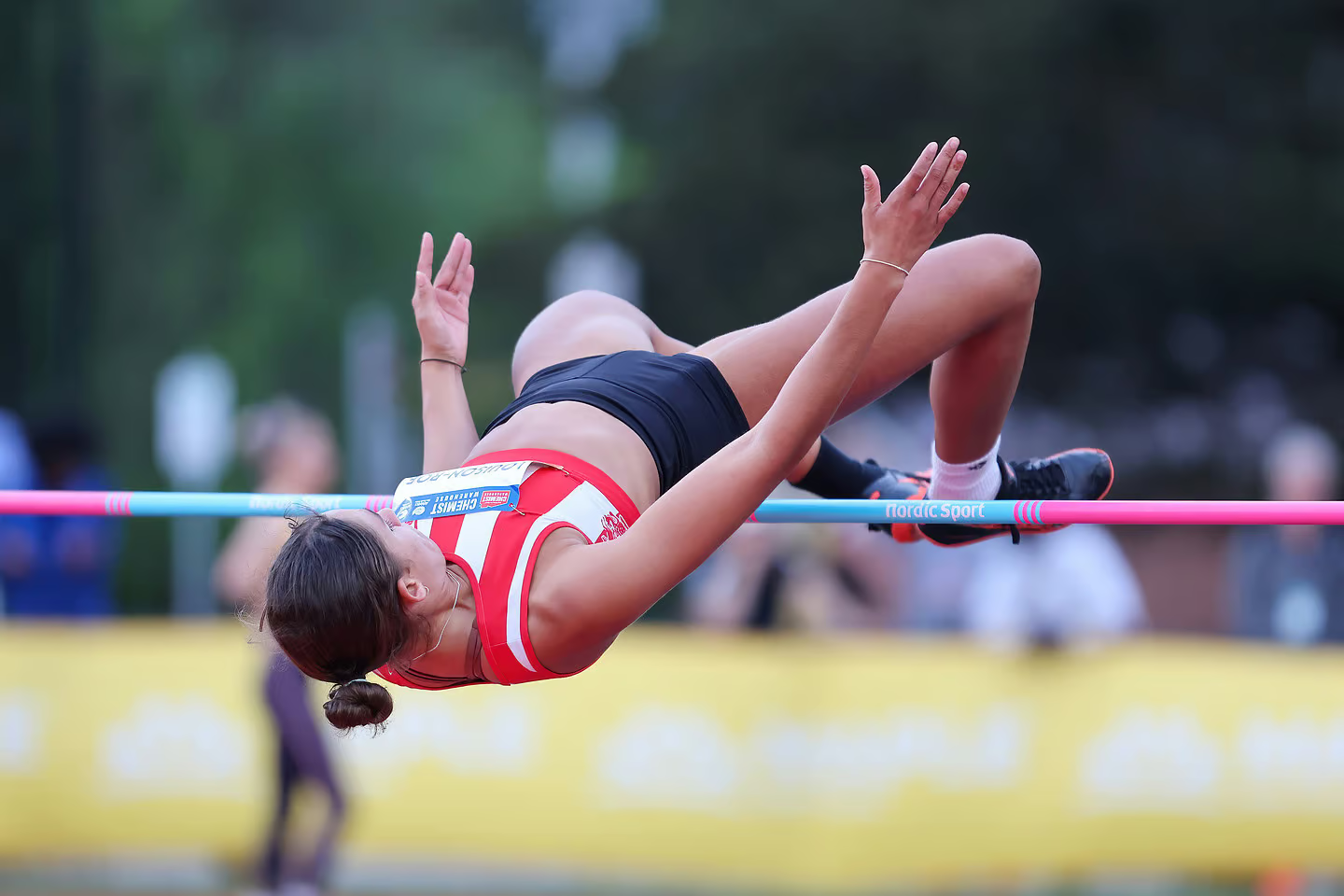
“We laid out a full program — sprinting, plyometrics, strength — all nice and rhythmic,” Karen explains. “The aim was an easy 1.90 season opener.”
That approach is now paying clear dividends. Louison-Roe opened her season at 1.90m, jumped consistently in the low 1.90s, and then delivered a breakthrough 1.95m performance when conditions and bar progressions aligned in the ACT.
“I knew something was coming,” she says. “I just needed the chance to pick my own progressions. When I jumped 1.95, I was like — oh my gosh.”
Strength as freedom
Ask Louison-Roe what has changed most in her jumping, and the answer is immediate.
“Strength,” she says. “Everything is so much easier now. High jumping feels easy because my body actually has the strength to do it.”
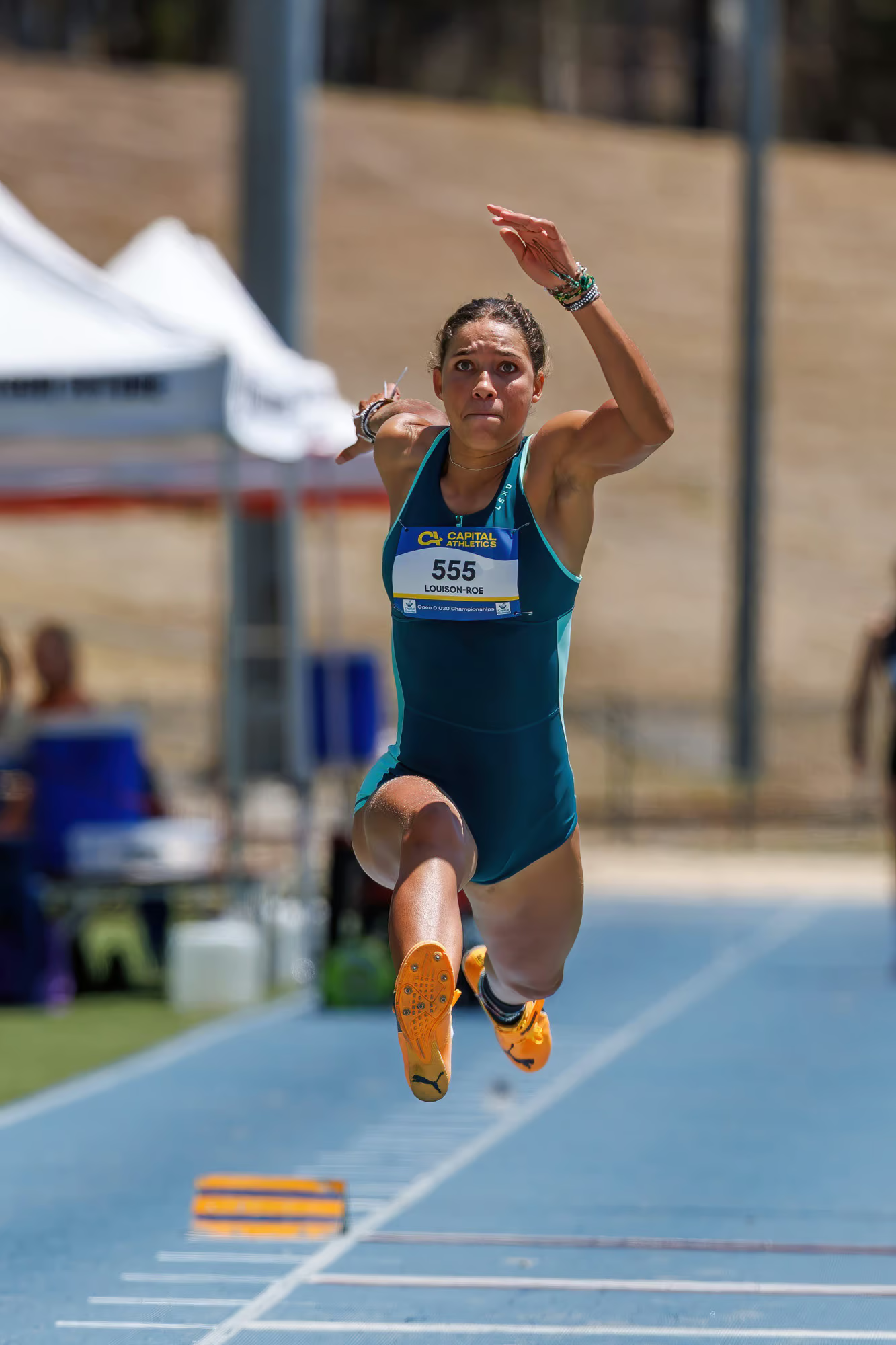
That foundation has translated across events. At the same meet, she returned to triple jump, an event she had stepped away from as much formal training for, and surprised herself with both performance and enjoyment. Her 13.31m leap ranks her second in Australia during the Commonwealth Games qualifying period.
“We don’t train triple much anymore,” she says. “But it made me realise how much the strength work transfers.”
Karen sums it up succinctly.
“We’re building a robust athlete.”
Injury-free, balanced, and grounded
Louison-Roe has avoided serious injury throughout her career so far, something she credits to smart training and her early gymnastics background.
“Gymnastics gives you strength in all the little random areas,” she says. “It keeps you together.”
Away from the track, life balance comes through art, painting and tending to two backyard greenhouses.
“It’s an escape,” she says. “You don’t have to think about anything.”
Emerging beneath champions
The timing of Louison-Roe’s rise is striking. Australian women’s high jump is currently led by Nicola Olyslagers and Eleanor Patterson: both world champions, both operating at the height of their careers.
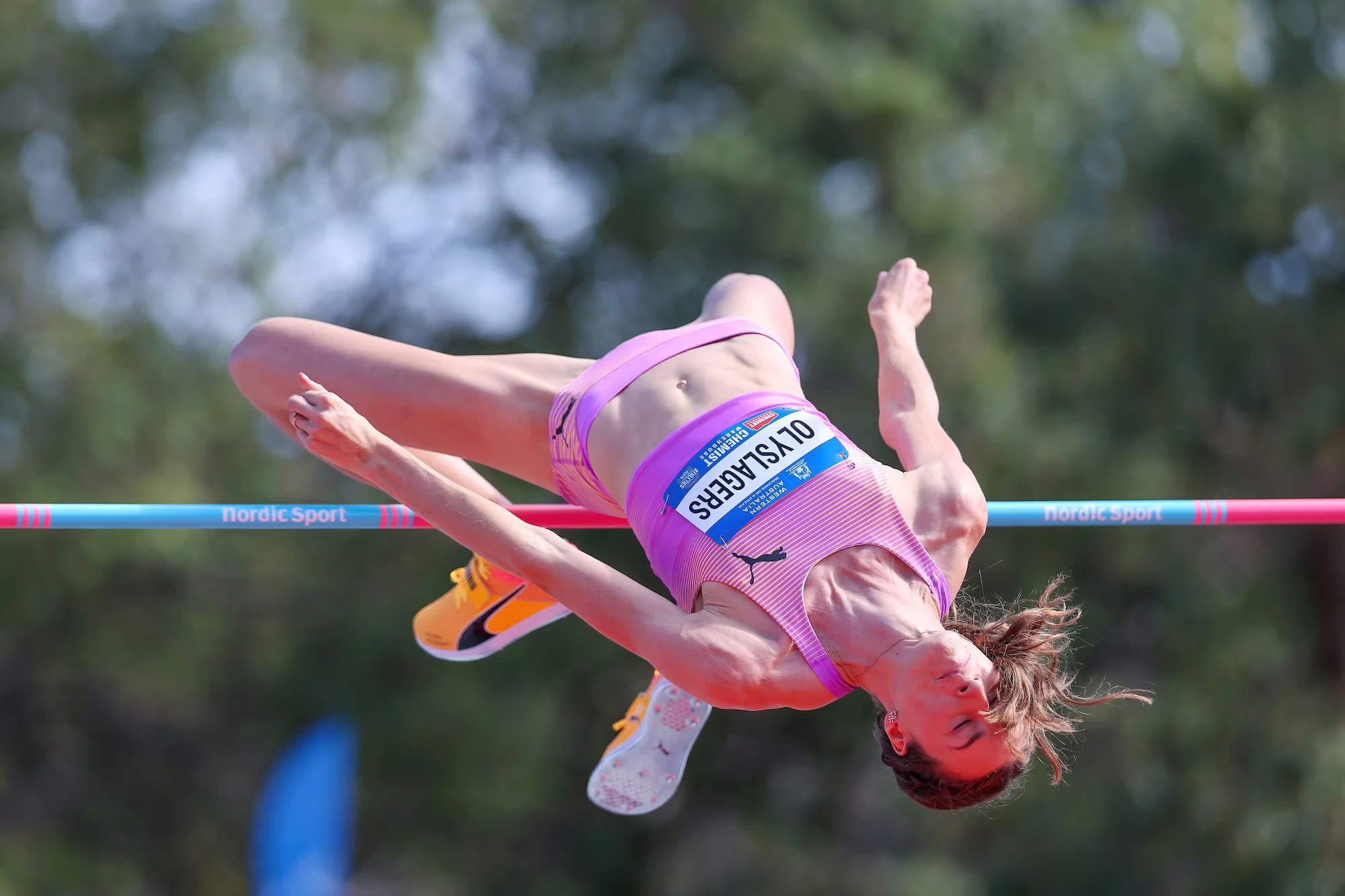
For Louison-Roe, they are not a barrier, but a benchmark.
“I think it’s fantastic,” she says. “You get to see what’s actually possible. They’ve achieved so much, and it shows that it can be done. And it can be done here, in Australia.”
She has crossed paths with both often enough to see the standard up close. Olyslagers, in particular, has been a regular presence at domestic meets.
“I’ve gotten to know Nicola quite a bit,” Louison-Roe says. “We’ll chat between jumps, and our coaches get along well too.”
Patterson, by contrast, is more often seen moving between global competitions: a glimpse of where the pathway can lead.
“She’s always travelling, so I don’t see her as often,” Louison-Roe says. “But watching what both of them have done is incredibly motivating.”
While Olyslagers and Patterson are refining careers already rich with medals, Louison-Roe is building: laying strength, consistency and belief beneath performances that suggest far more is coming.
“If I can live up to what they’ve done,” she says, “that would be incredible.”
Looking ahead — with joy intact
With both Commonwealth Games and World Under-20 Championships on the calendar, Louison-Roe’s ambitions are growing, but remain grounded. The high jump events are a fortnight apart, with the Comm Games first.
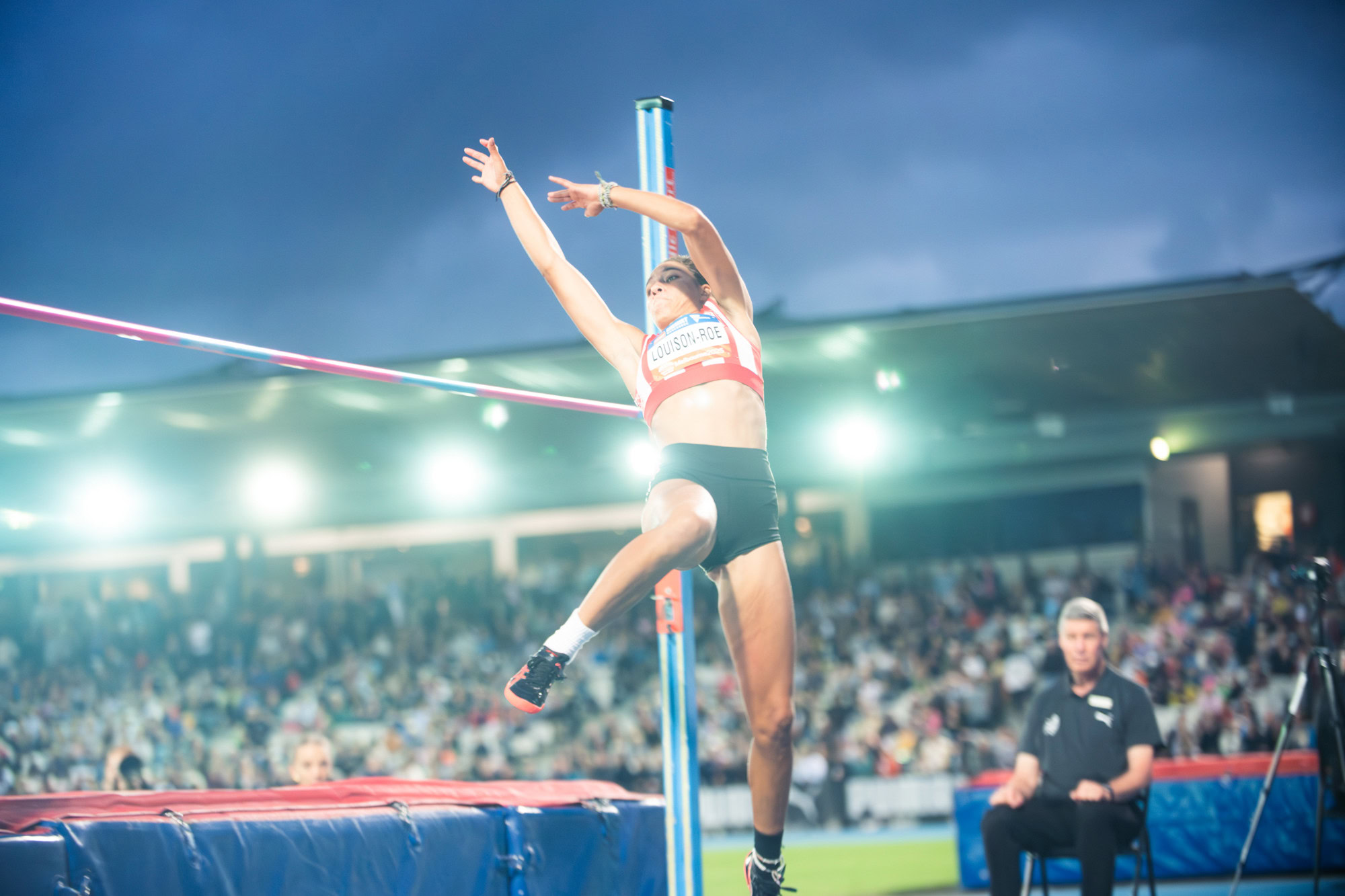
“At the start of the year, Commonwealth Games felt like a dream,” she says. “After jumping 1.95, I’m like… this can actually happen.”
Through it all, the joy remains unmistakable.
“Sometimes before I jump, I have to hold back my smile,” she says. “I’m just so happy that I’m there doing it.”
It’s a feeling that has followed her from backyard experiments to world stages. And one that suggests her best jumps may still be ahead.