
“The challenge was to fall in love with the sport I had never fallen in love with in the first place.”
Cover image by Chiara Montesano courtesy of Australian Athletics
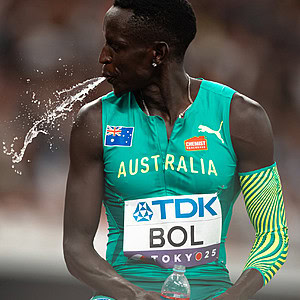
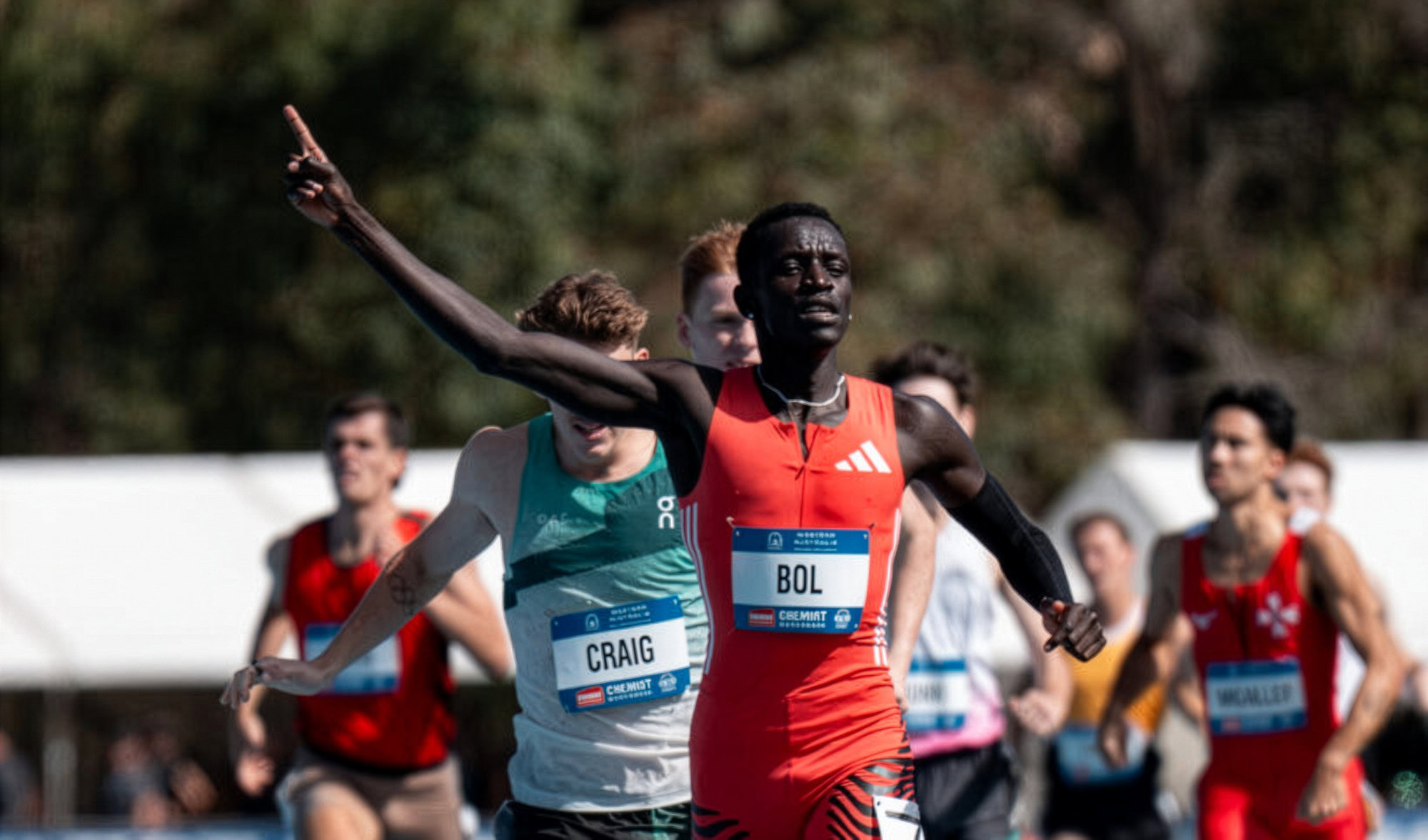
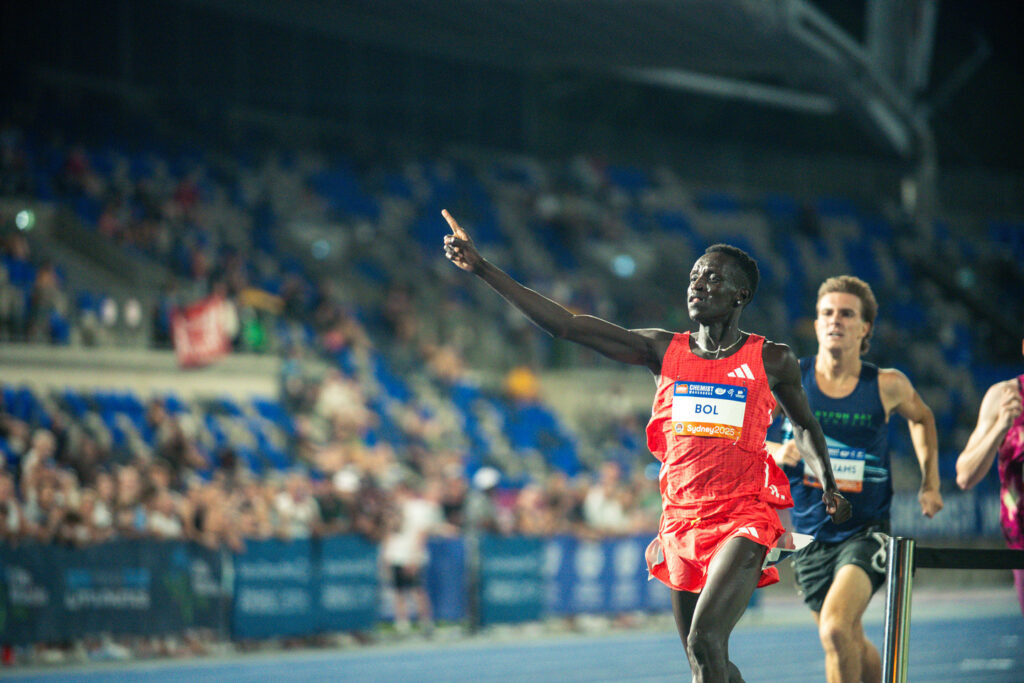
When Peter Bol saluted the crowd during the final metres of the Australian 800m final in Perth last year, we were witnessing the redemption moment in one of the most captivating sporting narratives of our time. After two tumultuous years, Bol looked his old self again. No longer weary, every step seemed to propel him towards a new chapter. Once again, Peter Bol had run the fastest time in Australian history – 1:43.79. As this all unfolded, however, coach Justin Rinaldi wondered if he was witnessing the final act of his athlete’s career.
“I thought nationals was going to be the last race of Pete’s career.”Peter Bol’s coach, Justin Rinaldi
“I thought nationals was going to be the last race of Pete’s career,” Rinaldi says. “We hadn’t spoken about whether he was going to retire or not, but I just had a hunch we would get to 2025 nationals and that would be it. So, we really wanted to go out with a bang in my mind.”
Although retirement would have felt premature, Bol’s return to the track following the withdrawal of doping allegations had not been easy for him. Almost one year on, even he acknowledges that maybe that race could’ve brought the curtains down on his career.
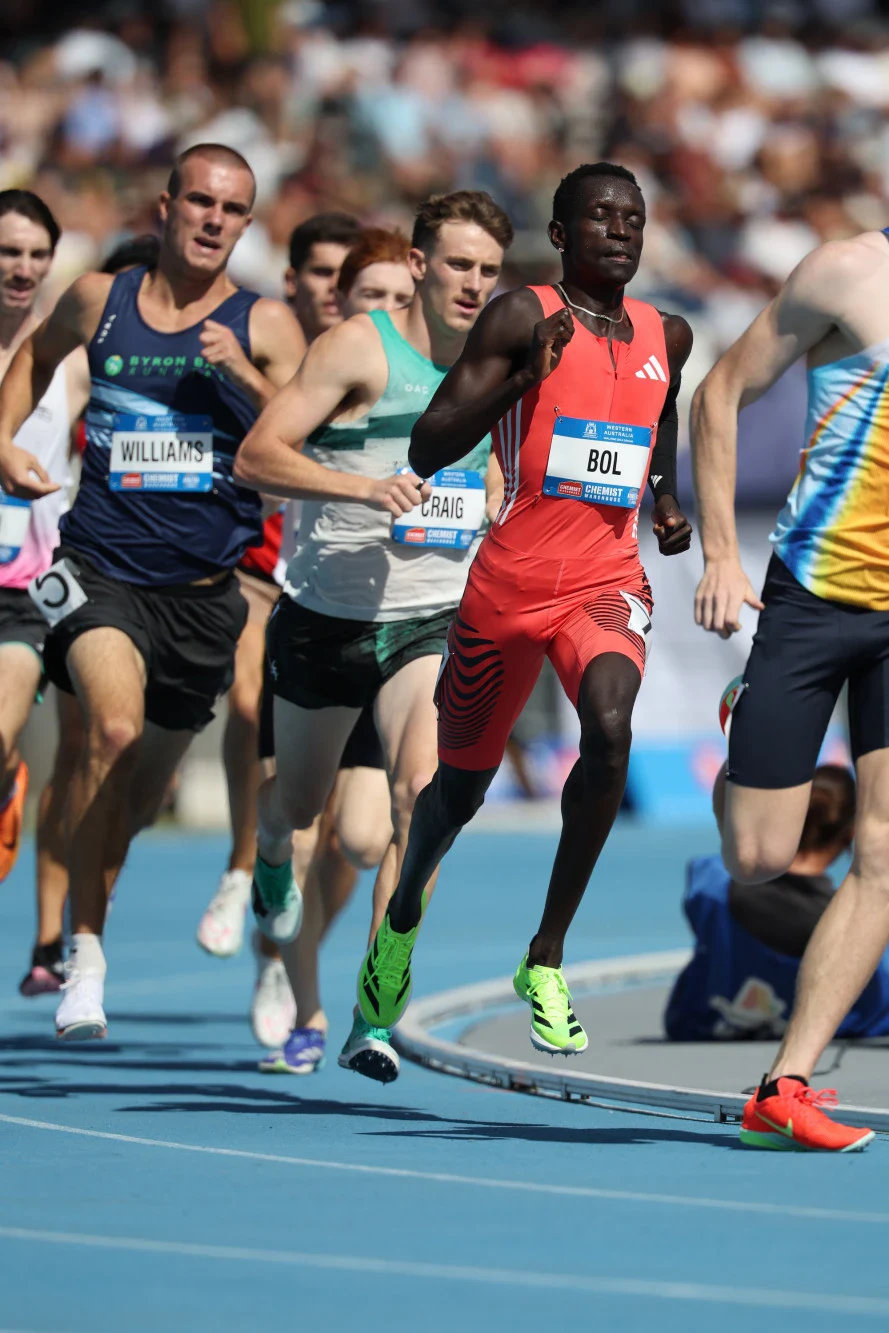
“I love running at home and to win nationals again with a home crowd, that was really nice,” he says. “It all came together that day. That actually should’ve been a retirement moment, right there.”
But that day, as Bol crossed the line, he glanced at the clock. The time seemed to shock even him. He raised both hands, almost as if surrendering. This couldn’t be the end of the story and he knew that.
The first international experience
When watching Bol command the track and speak with the accumulated wisdom of a decade-long career, it’s easy to forget the younger, more inexperienced athlete that stepped out onto an international track for the first time at the 2016 Rio Olympic Games.
“It was quite scary,” he reflects. “All the emotions get to you, it’s a shock. You forget how special the moment is because you’re trying to deal with it all.”
Although Bol felt immense pride to pull on the green and gold singlet for the first time, at 22 he felt unequipped to deal with the enormity of an Olympic Games. He placed sixth in his heat, far from advancing to the semi-finals.
“It started the morning of the race. I remember waking up at 3am and not being able to go back to sleep. That whole time, from waking up until the race, was just the highest levels of stress and discomfort. There were so many different thoughts and panic, just everything,” he says. “It was the nerves of having so many eyes on you and all the expectations you put on yourself. Even though crossing the line I was disappointed, it was probably the first time I felt relief.” “Pressure is not a good or bad thing, it’s just part of life. That is the thing sport has taught me the most.”Peter Bol
This baptism of fire taught Bol important lessons. Rather than being swept up in the novelty of a national team environment, he had to implement his own systems and routines. He had to work on his nerves too, to embrace pressure and master the art of adaptability. To this day, he values those lessons higher than any other.
“In life, you can plan but you never know what directions you will have to go. You just have to have the tools in place to shift and adapt to whatever life chucks at you. That’s been really important for me to understand,” he says. “I take this approach to life where you’re quite intentional, but also quite adaptable as things change and you’ve got to respond to the pressures that happen. Pressure is not a good or bad thing, it’s just part of life. That is the thing sport has taught me the most.”
Tokyo
This evolution in Bol’s mindset saw him rise to the top of Australian 800m running in the lead up to the 2021 Tokyo Olympic Games. Under the tutelage of two-lap guru Justin Rinaldi, he approached his second Olympics as a much more confident and sophisticated athlete than five years earlier. They both knew that with the right execution, anything was possible.
“I was really confident. I not only believed I was going to make that final, I really thought I was going to come back home with a medal. That belief wasn’t just words, it was real,” Bol reflects. “I was in great shape, physically. But I also knew I was in great shape in Rio. This time, I was in great shape mentally too. I just knew how to deal with everything that was on my hands. I knew where I was going, I had so much more experience this time around.” “I basically asked Pete the question: do you want to go for a medal or do you want to go for the win?”Justin Rinaldi
Two rounds and two Australian records later, Bol had cemented his place in the Olympic final. It made him the first Australian to make an Olympic 800m final since Ralph Doubell won gold at Mexico City in 1968. But the mission remained incomplete.
“I basically asked Pete the question: do you want to go for a medal or do you want to go for the win?” Rinaldi recalls. “Because when you race at this level, they’re two totally different tactics. Going for the medal, in my mind, is a little easier than going for the win. But he said he really wanted to go for the win, so we came up with a plan, which I thought was the best and only chance of him winning, and he executed it brilliantly.”
Although Bol hoped for a fast first lap, the elimination of renowned front-runners meant the slow early pace came as no surprise. The plan was to take up the running from the front, increasing the pace every 100m in the hope that he could run the field off their feet. As the race settled, Bol took the lead as planned and began the long wind up. He led into the latter stages unchallenged. Watching that final bend, an entire nation held it’s breath. For a fleeting, infinitesimal moment, the gold medal seemed within reach. At the top of the straight, however, his anguish became apparent, the effort etched all over his face. He kept fighting, a gallant fourth, mere metres separating him from the podium.
“I actually didn’t know how to feel,” Bol says. “Again, there’s a relief because even though you’re better at handling the emotions, you’re still carrying so much during that period. But there’s still a sense of disappointment. It’s probably the worst position you can come because you’re so close to that medal.”
Back in Australia, Bol had become a household name overnight. This meteoric rise made it hard for disappointment to linger. He left Tokyo with gratitude for the experience and for the outpouring of love that had come his way. But he also left with a new sense of what might be possible. The next goal, naturally, was to chase that global medal.He kickstarted that campaign by winning silver at the 2022 Commonwealth Games behind reigning champion, Wycliffe Kinyamal of Kenya. Then six months later, disaster struck.
The knock on the door
The knock on the door would have felt routine. Moments later, however, when Sports Integrity Australia officials informed Bol that he had tested positive for synthetic erythropoietin (EPO), his whole world changed. One can only imagine the deafening silence those official must have left in their wake when they left the apartment that day. I ask him if that moment was rock bottom.
“I wouldn’t say it felt like rock bottom”, he replies. “I’ve had many other times in life that were more rock bottom than that. [My family and I] have come from such difficult circumstances, we’ve had to leave people behind, and once you compare it to where we’ve come from, it’s been worse.”
Bol believes the tools he had acquired through his time in the sport allowed him to keep functioning during the six weeks between the leaking of his A-sample result and the B-sample that would eventually lead to his formal exoneration. His family, forever by his side, kept him afloat throughout that period.
The revelation hit Rinaldi hard too.
“Never in my wildest dreams did it cross my mind that Pete would take any performance enhancing drugs. I was shocked. My gut feel was always that Pete would never do this,” Rinaldi says. “For those six weeks, I didn’t sleep a lot. I was awake every night with thousands of thoughts going through my head.”
Sport Integrity Australia officially concluded their investigation at the beginning of August, 2023. Less than three week later, Bol found himself at the World Athletics Championships in Budapest, Hungary. The sharp turnaround proved too much. Trust in the system had spiralled and a siege mentality had understandably become a self-preservation strategy. He looked forlorn on the start line, a shadow of his former self.
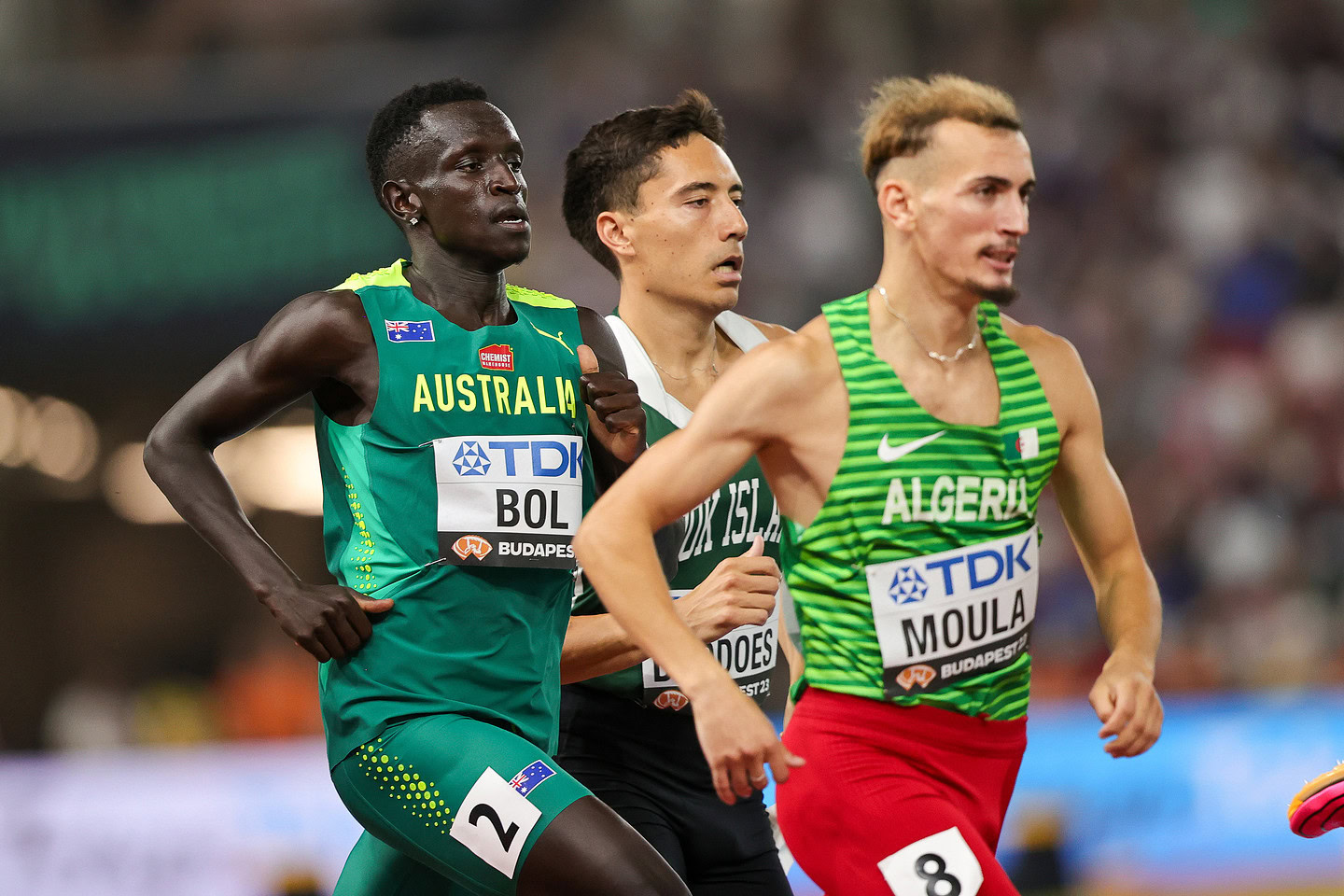
“I didn’t want to go,” he says. “I didn’t want to be there and I shouldn’t have really been there. It was the first moment I misjudged my own feelings. I was enjoying competing again, but I didn’t really want to be at a world championships. It wasn’t the sport, it was the place. I think it was too early.”
Rinaldi accepts the mistake in encouraging Bol to attend those world championships.
“I thought it was really important for him to show his face there after everything that happened, but he didn’t want to be there,” Rinaldi says. “He was really uncomfortable and he said to me after the heat, ‘thank god that’s over’.”
“I should have really listened to him and tuned in to how he was feeling,” he continues. “But, you know, when something happens, you just want to make sure that you’re not shying away from things and you want to show your face.”
The third act
Bol took a short break from the sport before commencing his 2024 Olympic campaign. It served not only as a reset, but a reorientation. He knew that if he wanted to reclaim his place in the sport, he had to want it.
“Coming back, the challenge was to fall in love with the sport I had never fallen in love with in the first place,” he says. “A part of handling everything so well was because it was easier for me to let [the sport] go. So, coming back to it, I was thinking what’s the purpose of trying to keep pushing. But you get fit, you get competitive, and I still wanted to see how far I could get, how quick I could run.” “It would be great to get to one more Olympics, but if not, it is what it is.”Peter Bol
With a third Olympic Games now under his belt and a new Australian record of 1:42.55, Bol has found his mojo again. With his sights now locked on the horizon, and a significant increase in his mileage from an average of 55km per week to 80km, thoughts of retirement are long gone.
“”I’m really excited for 2026,” Rinaldi says. “He’s running really well. He’s turning 32, but I think he missed two years in the sport throughout that saga. So, I look at him still as under 30 with a lot more to give in the sport.”
For Bol, it’s one day at a time.
“It would be great to get to one more Olympics, but if not, it is what it is,” he says. “I’m running quite well at the moment. But if that doesn’t happen, there’s so much more to look forward to in life anyways and I’ll be forever grateful to the sport.”