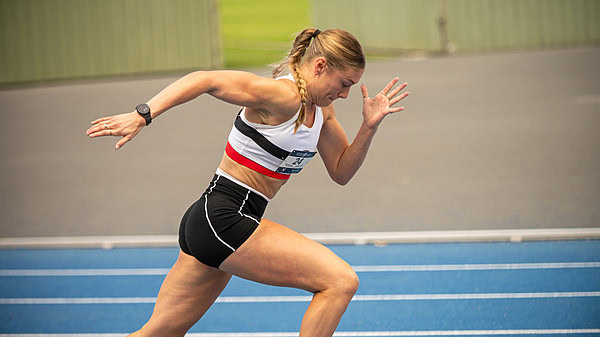

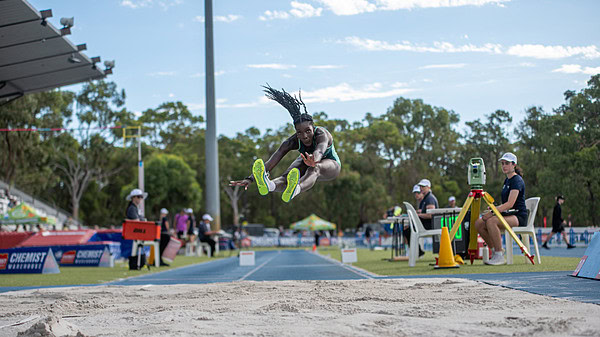


On a quiet Thursday night, Mia Gross might be found at a local athletics meet: not racing, just watching.
“If I’m here [in Geelong] I’ll just go down to Landy Field on a Saturday and watch the racing,” she said. “Or I’ll walk over to Albert Park and watch a Thursday night meet. I just absolutely love it.”
Gross laughs when she says it, but the description is accurate.
“I live and breathe athletics,” she said. “Like I’m one of those weirdos.”

That passion has made the Australian sprinter one of the sport’s most engaging personalities. Gross is not only racing internationally across the 100m, 200m and increasingly the 400m, she’s also documenting the journey along the way.
Her social media has become a window into the life of a professional sprinter: the races, the gym sessions, the recovery routines, the nerves, the travel, the setbacks and the celebrations. But the reason she first started sharing that life publicly had nothing to do with building a profile.
“There was a couple of points as to why I decided to start vlogging,” she said.
The first was family.
“When I go overseas, obviously I’m gone for so long and the time difference is crazy,” Gross said. “My parents are very… well, I’m very close with my family and they’re always like, ‘What are you doing today? What’s going on?’ So I wanted to create something that I could show them exactly what’s going on in my day-to-day.”
Growing up, her parents had rarely missed a race.
“My parents are the kind of parents that they’ve been to every single one of my races,” she said. “They fly everywhere. They watch me run. They’ll be at every single race.”
Travelling alone through Europe was a new experience for everyone.
“I’d never been alone before,” she said. “So I wanted to be able to show them that I’m actually okay… like no one’s stealing me, I’m fine, I’m learning new things.”
Showing the Fun in the Sport
The second reason for sharing more of her journey came from something she noticed in the next generation of athletes.

Through watching her younger sister — 10 years her junior — compete, and speaking to younger athletes at meets, Gross began to notice how much pressure many teenagers now feel around performance.
“A lot of people are very anxious these days,” she said. “They overthink about performance and doing well on the track becomes like their identity.”
That shift worried her.
“I feel like a lot of people weren’t finding the fun in track anymore,” she said.

So she decided to show what that enjoyment actually looks like.
“I wanted to be able to show people how much fun I actually have on the start line,” she said. “And how I deal with nerves and things like that.”
Sometimes that means dancing before a race.
It might seem like a small thing, but the response has been powerful.
“I had a girl maybe three weeks ago who said she was really nervous on the start line,” Gross said. “Then she saw my vlogs and knew that I dance a little bit to relax. So she tried dancing on the start line and then she ran a PB.”
Those moments make the time spent filming and editing worthwhile.
“Little things like that make me think the vlogs are actually helping people,” she said. “Helping them have fun with it and not be too stressed.”
Loving the Journey
There’s another reason Gross likes documenting the life of an elite athlete: one that looks far into the future.
“I thought it would be amazing when I’m like 80 years old and I’m an old grandma with a walking stick and I can say, ‘Yeah, I did this and this and I went to this place,’” she said.

Because even athletes can forget how remarkable the experience is.
“You travel so many countries, you race every week,” she said. “But you get so wrapped up in the next goal — the Olympics, the World Champs — that you forget how incredible the journey actually is.”
That perspective has been shaped by years spent watching rather than competing.
“I was injured every single year from 13 up until the Olympic year,” she said.
And not minor setbacks.
“These were like whole-season injuries,” she said. “I’d basically just run states and nationals.”
The time on the sidelines changed how she views competition.
“I really admire anybody that’s willing to put themselves out there on a start line,” she said. “Because there are no variables. It’s just you.”
Racing to Find Out
That mindset helps explain why Gross is comfortable racing even when she knows she may not yet be in peak form. “I’m not afraid of failure or finding out where I’m at.
I’m always open to trying new things and learning.”Mia Gross

Earlier this season her coach suggested she skip a 400m race at the ACT Championships.
“My coach said to me on the Tuesday, ‘Mia, you’re not running good at all. I don’t think you should run this four.’”
Gross had a different idea.
“I just said, ‘I want to know where I’m at.’”
Because racing offers something training cannot replicate.
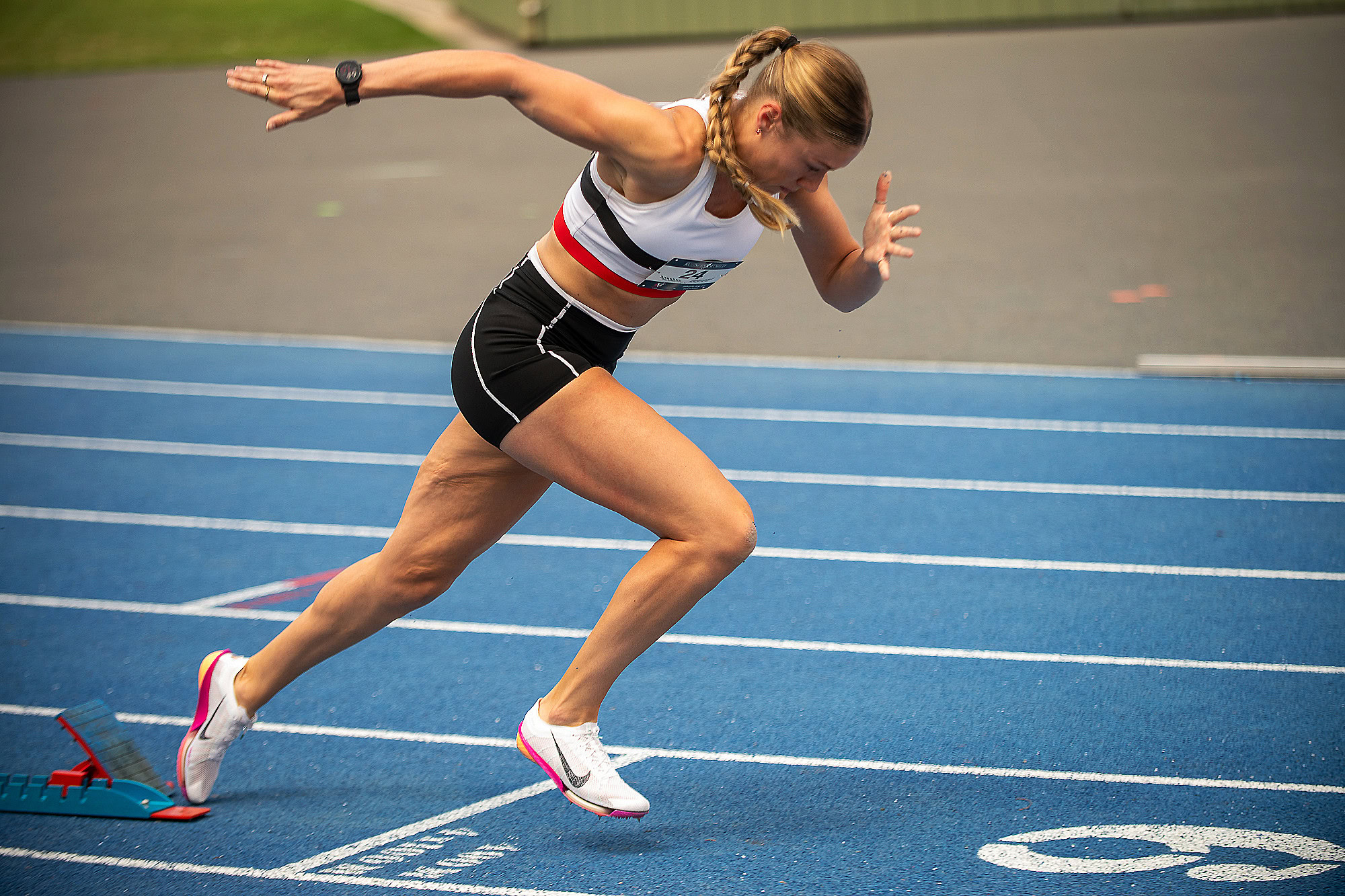
“You can’t factor in race-day nerves or race-day adrenaline in training,” she said. “Race day is just another category.”
And in her mind, the timing of peak performance matters far more than early-season results.
“I don’t need to be the best in February,” she said. “I need to be the best in April at Nationals and then at the majors later in the year.”
A New Challenge: The 400m
Gross remains one of Australia’s most versatile sprinters, regularly competing across the 100m, 200m and 400m.
“I love the one, two and the four and I’ll probably run the one, two and the four for the rest of my life,” she said.
Right now, the shortest sprint has her attention.
“At the moment the 100 is my favourite,” she said. “The two’s actually not my favourite right now — it kind of shapeshifts.”
But long-term she can see herself moving further up the distance ladder, and not just in relays, where she has shone recently.
“I’m kind of looking down the barrel of the fours being my final stop,” she said. “I think I can be really good at it if a lot of the puzzle pieces come together.”

That ambition carries extra significance because, for years, running longer distances simply wasn’t possible.
“I had to stop running fours because I had severe asthma,” she said. “I couldn’t even get through 200.”
Then came more serious medical complications.
“I had an abscess grow on my kidney and I became septic to the medication,” she said. “Then I developed pancreatitis and a lot of gut issues.”
The consequences were dramatic.
“I literally just couldn’t run far at all,” she said. “If my coach said we had a 30-second turnaround, I’d cramp up and have to lie in the fetal position.”
One session ended with a call home.
“I had to get my mum to pick me up from a run-jog session because I was in so much pain,” she said.
Rebuilding
Over the past few years Gross has slowly rebuilt her ability to handle longer training.

“I’ve been really trying to work on my gut issues for the last three years,” she said.
“It’s been really good and now I can start to run a little bit more.”
There is still work to do.
“I still can’t run 400 training consistently at 100 per cent,” she said. “But I’m slowly getting better and better.”
If the progress continues, she believes the event could eventually become a major strength.
“Once I get it fully sorted,” she said with a grin, “I’ll be a very happy lady.”
Still Loving It
In the meantime, Gross embraces everything that comes with elite sprinting: the technical work, the gym sessions, the recovery routines and the constant pursuit of small improvements.

“When I went all-in on trying to run fast I was like, ‘Oh my God, this is a full-time gig,’” she said.
But through all the injuries, training blocks and ambitions, one thing hasn’t changed.
Her love for the sport.
“I just absolutely love it,” Gross said.
And that joy, more than anything else, is what she hopes people see.