
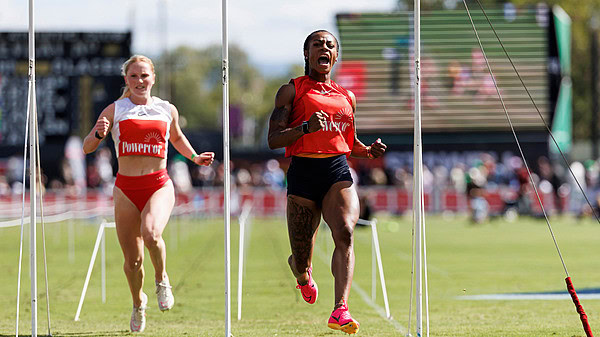


Australia’s Newest Sprint Star—Made in NZ, Claimed by Australia, Powered by 9.96
Australia has a long and storied tradition of adopting New Zealand’s best exports. Phar Lap? Naturally Australian (don’t look too closely at the birthplace). Crowded House? Absolutely Australian… except for the parts that aren’t. Russell Crowe? Australian when he’s winning Oscars or supporting South Sydney, maybe not when throwing phones.
And now, in the proud lineage of “it’s basically just Australia anyway,”
Edward Osei-Nketia has officially completed his transfer of allegiance from New Zealand and is eligible to represent Australia on the world stage.
One of the most gifted sprinters in Oceania — a 9.96 man in April this year (+2.4 m/s)— Edward joins a booming generation of Australian speedsters.

A Career That Crossed the Pacific—And Came Home Faster
Edward’s athletic journey has travelled an extraordinary loop.
Born in Auckland, with his father Gus being the former NZ record holder.
Grew up in Canberra.
After missing selection for New Zealand’s Tokyo Olympic team — despite being qualified — he was selected the next year at the World Championships in Oregon, then stepped away from athletics entirely.
He chased a new dream: American football.
- Signed to play wide receiver for University of Hawaii in 2023
- Learned playbooks, ran routes, lifted heavy things
- Didn’t play a game
- Maybe realised that being hit by linebackers is less enjoyable than running 100 metres unopposed
So he returned to the track, transferring to the University of Southern California, one of the world’s elite sprint programs. Now 24 years old, he is entering the prime of his career, sharper than ever.
And now?
“I am 100% with Australia from here on out.”
A Star Who Beat Australia Before He Became Australian
Edward has been terrorising Australian sprinters for years.

At just 17, he announced himself at the 2019 Australian Championships:
- 10.17 NZ junior record in the semi
- 10.22 to win the national title
- Holding off Rohan Browning (10.28)
- With Jack Hale diving for bronze (10.34)
That race felt like a preview of a fast-approaching future.
Now, that future belongs to Australia.
A Cheeky Trans-Tasman Transfer in the Spirit of Federation
NZ Prime Minister Helen Clark once joked that “New Zealanders who go to Australia raise the average IQ of both countries.”
In this case, however, the equation is pretty simple:
It’s a clear loss for NZ, driven partly by restrictive high-performance selection policies that have kept even world-class eligible athletes off major teams. Australia moved away from that approach about a decade ago, broadening pathways and athlete support.
But let’s give credit where it’s due: Right at the pointy-end New Zealand High Performance is thriving.
At the 2025 World Championships in Tokyo, NZ finished 5th on the medal table, thanks to:
🥇 Geordie Beamish – Men’s 3000m Steeplechase
🥇 Hamish Kerr – Men’s High Jump
🥉 Maddi Wesche – Women’s Shot Put
A nation of five million, outpunching giants. At the absolute pinnacle, their system works. Below that, it doesn’t.
Why Australia Is Grinning
Edward brings instant, game-changing upside:
- 9.96 windy (Just 0.03 behind the Australian record, #2 Australian all-time list level if legal)
- International championship experience
- USC training pedigree
- Relay depth that suddenly looks world-class
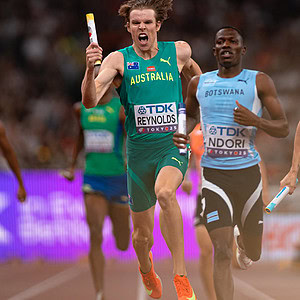
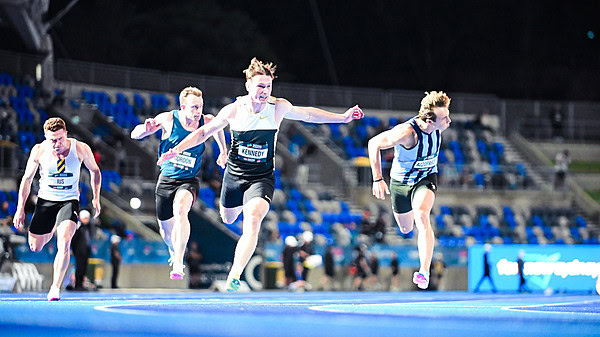
Picture a 4x100m team – if they all committed to it and were health at the same time – of Eddie Osei-Nketia, Lachlan Kennedy, Rohan Browning and Gout Gout. What could they do come LA in 2028? Win medals?
Australia is entering its deepest sprinting era in modern history.
A New Chapter in a Very Old Rivalry
New Zealand might still claim spiritual ownership, and fair enough. Australians have always been creative about birthplace logic.

But the paperwork is complete:
🇳🇿 Born in Auckland
🇺🇸 Sharpened in Hawaii and USC
🇦🇺 Now officially Australia’s sprinting firepower
Fun fact: New Zealand was eligible to join Australia at federation in 1901.
They didn’t.
But 124 years later, we’ll happily take this elite instalment of sporting talent.
What Comes Next?
With his allegiance now formalised, Edward can target:
- World Relays qualification
- Commonwealth Games
- 2027 World Championships
- LA 2028
- Brisbane 2032, where a packed home crowd may roar him down the straight
- Relay teams with genuine global ambitions
The rivalry just intensified.
The banter just got sharper.
And the sprinting?
It’s about to get extremely quick.
Welcome, Edward.
Australia just got even faster.