In 2006, fifteen-year-old Vanessa Low left her home in Ratzeburg, Germany to go meet friends in a nearby town. It was a trip she had taken many times before. She was an adventurer, always out and about, the family’s “little butterfly” as her dad would say. But she never made it to her friends that night.
Hours later, Vanessa’s parents reported her missing to the police. A young girl had been flown to the nearest hospital, the police told them. They said it was serious.
When they arrived, Vanessa lay in a coma, fighting for her life. She had been struck by a train after falling from the station platform. The impact had immediately amputated her left leg above the knee. Unable to stop the bleeding, doctors later made the life-saving decision to amputate her right leg too. The screws from the train tracks had also become embedded in her back, damaging the spine. Forty stitches in her head were another confronting reminder of how lucky she was to be alive. “Basically, every bone in my body was broken”, the now three-time Paralympic champion remembers.
Something 15-year-old Vanessa Low would never have imagined: signing autographs in Canberra after her 2024 Paralympic victory representing Australia
It’s hard to fathom how this young girl survived, or the strength and willpower it would have taken to process that moment. In an instant, everything had changed. This is the story of how that girl became one of the greatest Australian Paralympians of all-time.
One Day at a Time
It took over a month for Vanessa to become fully aware of her surroundings and almost six months until she left hospital. But those months were just the first steps on a lifelong journey in coming to terms with what had happened that night at the train station.
At first, that process could be broken down into fundamental goals.
“I had to wake up and deal with it first. I had to grow into the situation and accept it,” she says. “I took it a day at a time. The first thing was, I just wanted to go home. I didn’t want to be in hospital anymore. Then I started rehab and I was learning how to live life. Then it was about gaining my independence and returning back to life. There was always something to focus on.”
Beyond these physical aspirations, however, Vanessa also had to navigate the emotions of those around her.
“My parents had it much tougher because they had to watch me do it and there was nothing they could do to make it easier,” she reflects. “I realised how hard it was for the people around me. But at the same time, I’ve realised how much pressure it put on me when, at least initially, you had to be so strong for everyone else because you see their pain and how difficult it was for them to deal with.”
As humans, our instincts urge us to reach out when people are struggling. We want to lift people up, to shoulder their burden. But for Vanessa, the overnight shift in what people expected from her felt jarring. She had always been the girl who dreamt of exploring the world, but now the bar for success in her life felt much lower than before.
“I think one of the things I was processing was how the expectations for myself had changed so much. When I lost my legs my whole narrative changed. Everyone did everything for me. They would hold open doors. They would carry me up and down stairs, which I needed in the beginning, but people were physically and emotionally taking everything. After a while I got used to that,” she says.
“I had to understand that I was still in charge of what I want my life to look like. People saw the physical changes but they didn’t always realise that inside I was still the same person with the same desires and passions.
Vanessa Low
That took a long time to redefine and figure out for myself.”
Even with the perception of lower expectations, however, Vanessa took on every challenge with the stubborn grit that would remain with her forever. As a runner in her youth, she never doubted that one day she would run again despite the experts telling her this was unlikely for double above-knee amputees. Her Physio got her into the gym, threw her into the pool, and gave her the first glimpse of para-sport. She wanted to prove those experts wrong.

The first time she tried to run in prosthetic, she fell more than thirty times. “I was falling more than I was running,” she says with a laugh. With persistence, she eventually proved that she did have the strength required to run on prosthetics. But the doubters remained. Not many Paralympians ran with a disability like hers and many of the German national coaches dismissed her chances.
“The amount of times I heard ‘no’ because there was no one like me at the Paralympics and people thought it was impossible,” she says. “They didn’t want me because people like me didn’t run. They said there was no way I’d be competitive . But I’ve always been a stubborn person, so I said let’s just give it a go anyway.”
When Doubt Is Louder Than Belief
This might be the perfect time in the story for the fairytale transition. You might be thinking that this next chapter in Vanessa’s story will see her throw off the shackles of doubt to become the champion we now know so well. For a moment, that promise did beckon. But as she walked onto the track at the 2012 Paralympic Games, she didn’t feel the strength of the girl who had overcome the unimaginable. All she felt was a sense that, maybe, this stage was not meant for her.
“I didn’t feel like I belonged there,” she says. “I didn’t feel like I deserved to be there.”

She placed fourth in the 100m and sixth in the long jump with a distance almost two-metres shy of her future world record mark. After years of perseverance, the tank was empty. She made the decision to retire from the sport.
Only months later, however, Vanessa was given an ultimatum that coaxed her fire back to life. On a night out with a teammate and their athletics-coach husband, Roderick Green, she was tempted by his proposition: “I’ll coach you to a gold medal. But only if you move to the US.”

“He was the first person to not doubt it, not question it, not think I would be better off in a different sport or a different event. For the first time, it was about what do you believe in and what do you believe you can do. Whatever that is, we can make it work,” she says. “I think that really changed my mindset because it wasn’t just someone blindly believing in me, but someone with a plan. He understood that physically, of course, I had it tougher. But what I was lacking was confidence and someone to push me along.”
The first week in the US nearly broke Vanessa. At long last, the cotton wool that had protected her since the accident was ripped away.

“For the first time, I was physically broken down,” she remembers. “The training was horrendously hard. On the third session, I had twelve blisters, my hands were bloodied. But it was only there to build me back up and give me the confidence that I can do hard things.”
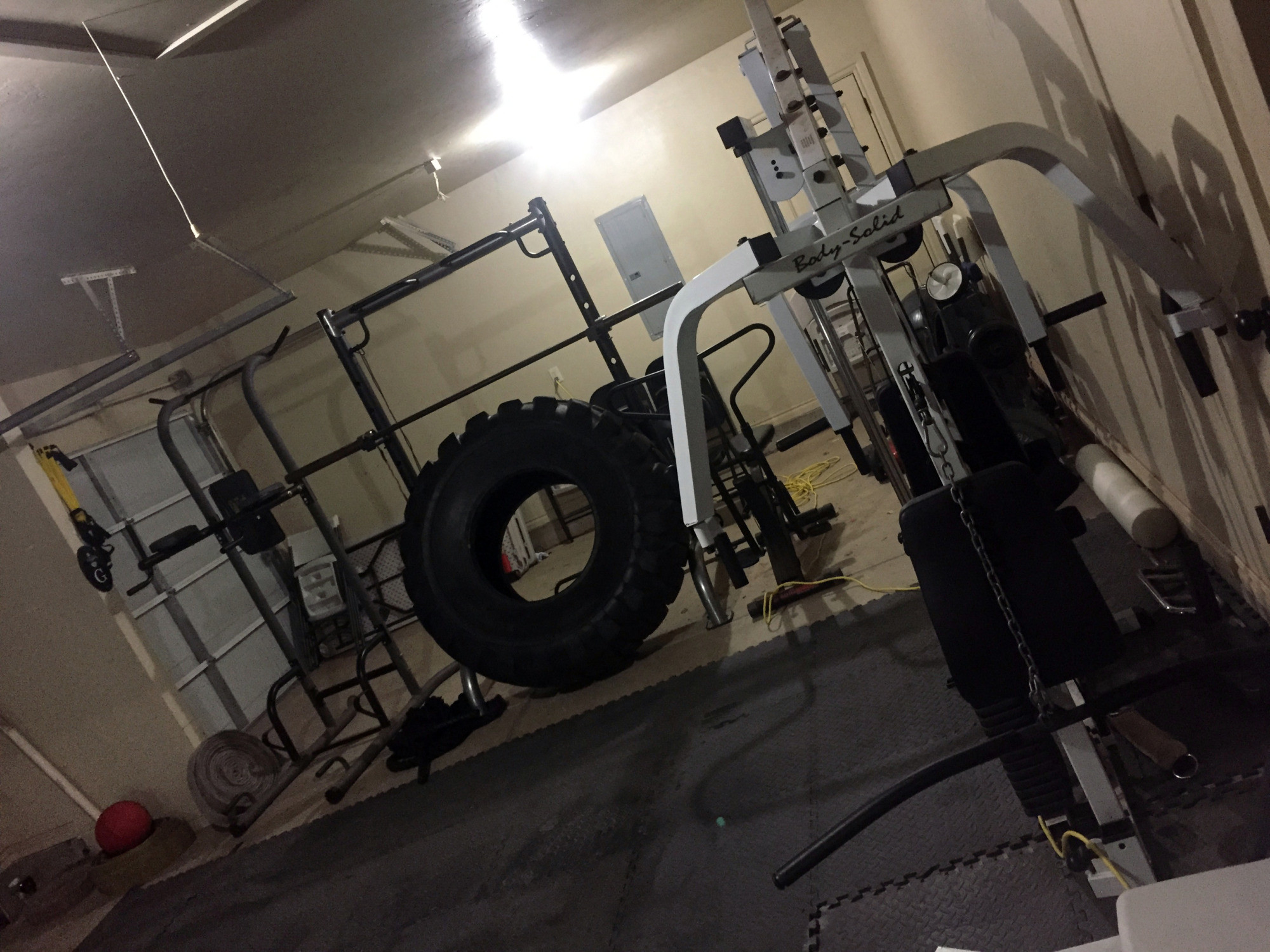
Training out of a garage gym and on the road, Vanessa threw herself into the training with a newfound hunger. For the first three months, she didn’t run, spending four hours lifting in the gym, finally making up for the strength lost during her years of recovery. When they did hit the track, the first barrier to break was in her self-belief.
“I remember when we first started running and he [Green] told me to run 80m reps in a certain time. I asked ‘how many reps?’ and he said “as many as it takes until you run that time’,” she says. “After over twenty reps, I still hadn’t run the time. But suddenly, I got so angry about it and just put it all into the next rep. For the first time, he saw that he could push me to the point where I actually tried. Learning how to do that made me a fighter. It took those sessions for me to learn what I could do.”
Built in the Garage
When Vanessa Low walked onto the track at the 2016 Paralympic Games almost four years later, she did so as a completely revolutionised athlete. This time, she felt as though the stage was built just for her.
“That was the first time walking into the stadium where I knew I was the best athlete there and I knew that I was going to win,” she says. “That confidence comes from knowing that you’ve put everything into being the best you can be. I had worked as hard as I could, probably harder than anyone else. In London, I lost before I’d even started. In Rio, I had won before the first jump.”
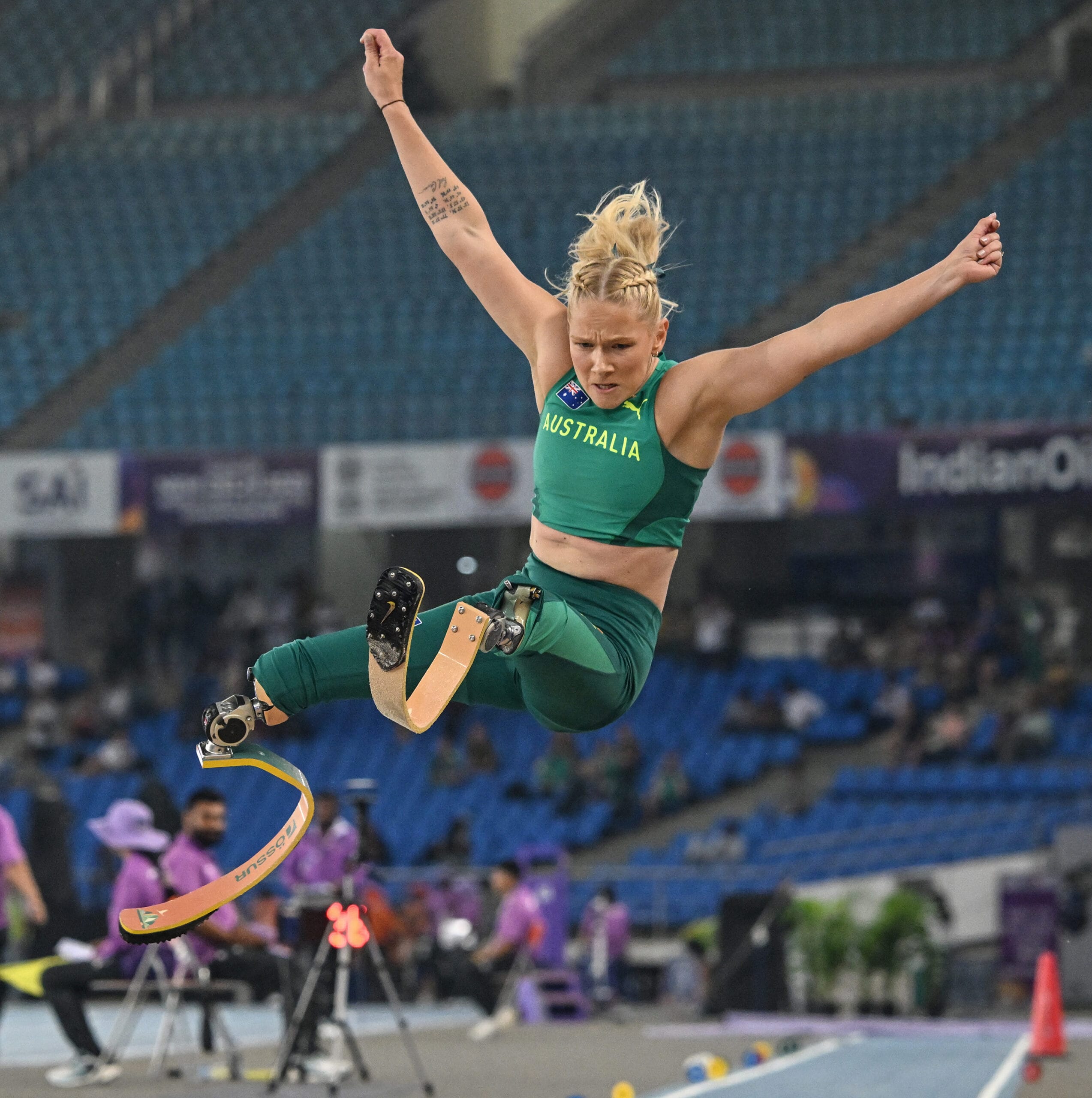
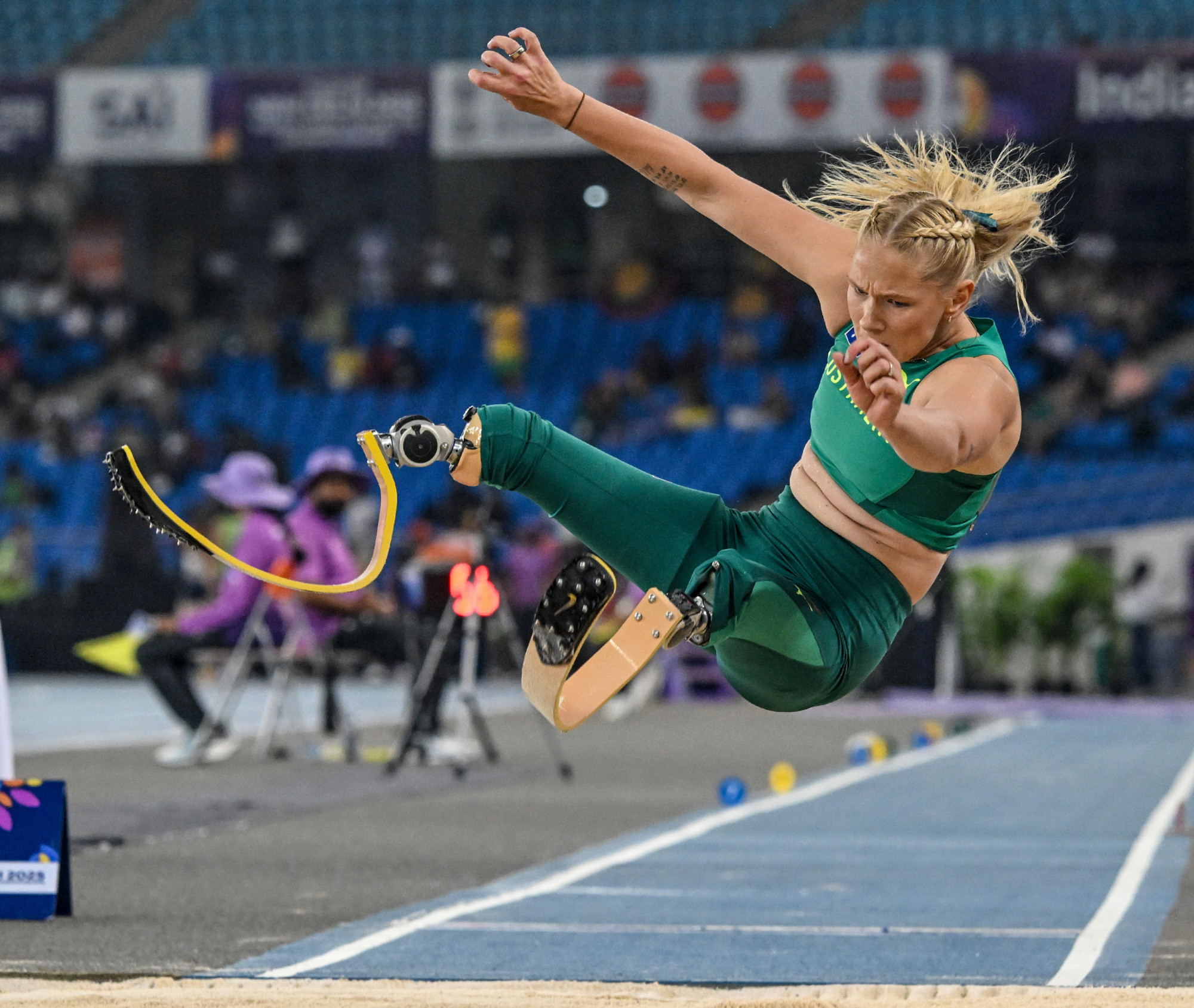
Vanessa dominated the competition, jumping a new world record of 4.93m. In ten years, that young girl who had laid in the coma fighting for her life had become Paralympic champion.
“I think the biggest reflection from that day was, obviously my parents were happy because I had won gold, but I think this was the first time my Mum knew I was going to be okay,” she says.
“It wasn’t because I won the medal, but because I had found my way in life.”
Vanessa Low
The Green and Gold Chapter
Throughout that Paralympic cycle, Vanessa had grown close to Australian Paralympic champion Scott Reardon. She had called him that first week in the US, with tears in her eyes, to show him her bloodied hands. Scott had been there to catch her during those formative moments. After hours spent video-calling from opposite sides of the world, they had started dating, and following the Paralympics, Vanessa made the decision to move to Australia.
“Scott had been there for me through a lot,” she says. “No one at home would have understood why I had taken this journey. When it was hard, they would have said ‘you’re stupid, just come home. You can still be an athlete, just go the easier way’. It took someone else in the sporting world to understand the nuances.”
For most of her career, Vanessa had operated outside the German system. That logistical balance had become draining. The couple had also hatched a dream that one day they would compete on the same team together at a Paralympic Games. They agreed that Australia would be that team. By December 2016, even Prime Minister Malcolm Turnbull knew about the plan. Eighteen months later, Vanessa became an Australian citizen and by 2019 she was donning the green and gold for the very first time.

“When I first made the team, I was a little concerned that I wasn’t going to feel welcome or whether I’d feel like an outsider,” she says. “But that’s not how Australia works. I know that now. Australian culture is multicultural and people embrace that. It felt like home.”
A world championship gold medal that year became another Paralympic gold medal at the 2021 Paralympic Games two years later. She not only extended her world record with a jump of 5.28m, but her and Scott lived out their Paralympic dream together.
“Tokyo was different, because life was really good. I had it all. But there was a different pressure,” she says. “Winning the second one is almost harder because you’re defending and you can get caught up in the pressure of that. But I knew I had done the work and nothing compares to that feeling.”
Motherhood and Momentum
Vanessa had never really wanted kids, but after Tokyo something shifted. Although she wasn’t ready to walk away from the track, the time felt right.
“I didn’t know what to expect, it was a bit of a science experiment,” she says. “I didn’t know anyone else that was a double-leg amputee who had a baby.”
Three months after falling pregnant, Vanessa could no longer use her everyday day legs due to the swelling.
“A lot of the mobility I had fought so hard for, I lost in everyday life,” she says. “That was a really big eye opener. It made me realise how important it was for me to be fit and active. That my sport was an investment in my life quality.”
Throughout the pregnancy, Vanessa continued to train. She ran up until twenty-three weeks and even completed a water-running session the day before giving birth. In 2022, little Matteo came into the world.
When it came time to return to the high-performance environment, Vanessa’s team had carefully curated a plan that would see her fit and firing for the 2024 Paralympic Games. But just one year later, she found herself competing at the World Para-Athletics Championship, winning the bronze medal.
“We decided that we would take the long way, no shortcuts,” she explains. “If you cut those corners in the first bit , you’re always going to lose it at the other end.”
This disciplined progression had actually fast-tracked her return by avoiding the speed bumps that hit hardest when people rush the un-rushable. It was this obsession with following the process that allowed her to eventually stand at the top of the runway at the 2024 Paris Paralympics with all the confidence in the world.
“That was the first tine where I stood on the start line and I actually didn’t care whether I won or not,” she says.
“I felt I had already won because not only had I successfully returned to sport after pregnancy, but I had the most perfect life. I had everything I ever dreamt of. Matteo quite literally couldn’t have cared less if I won or not.”
Vanessa Low
But she did win, and for the third time with a world record mark. Since then, Vanessa has extended that record out to 5.71m. The six-metre mark now beckons.
“I’m not just here to compete for gold medals now,” she says. “I want to be one of those athlete that leaves a mark for future generations to chase.”
After the life she has forged, with the spirit of that little girl that refused to let the world beat her down, anything is possible.
“Just because something hasn’t been done, doesn’t mean it can’t be.”
Her life is a testament to that.
Read Jaryd Clifford’s other features…
Rewriting the Final Act: Peter Bol’s Unfinished Story

“The challenge was to fall in love with the sport I had never fallen in love with in the first place.”