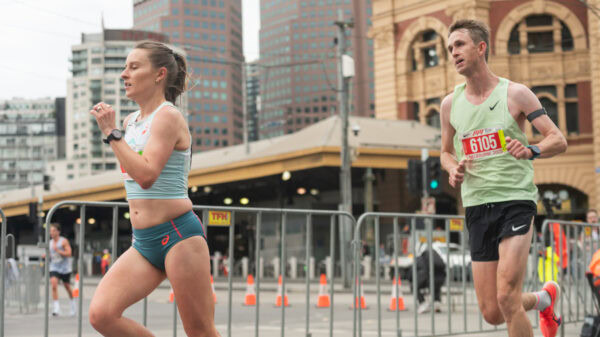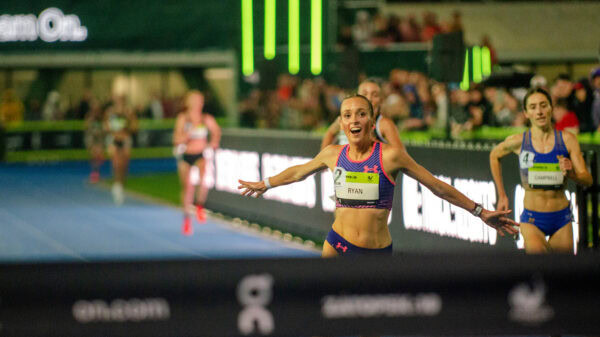

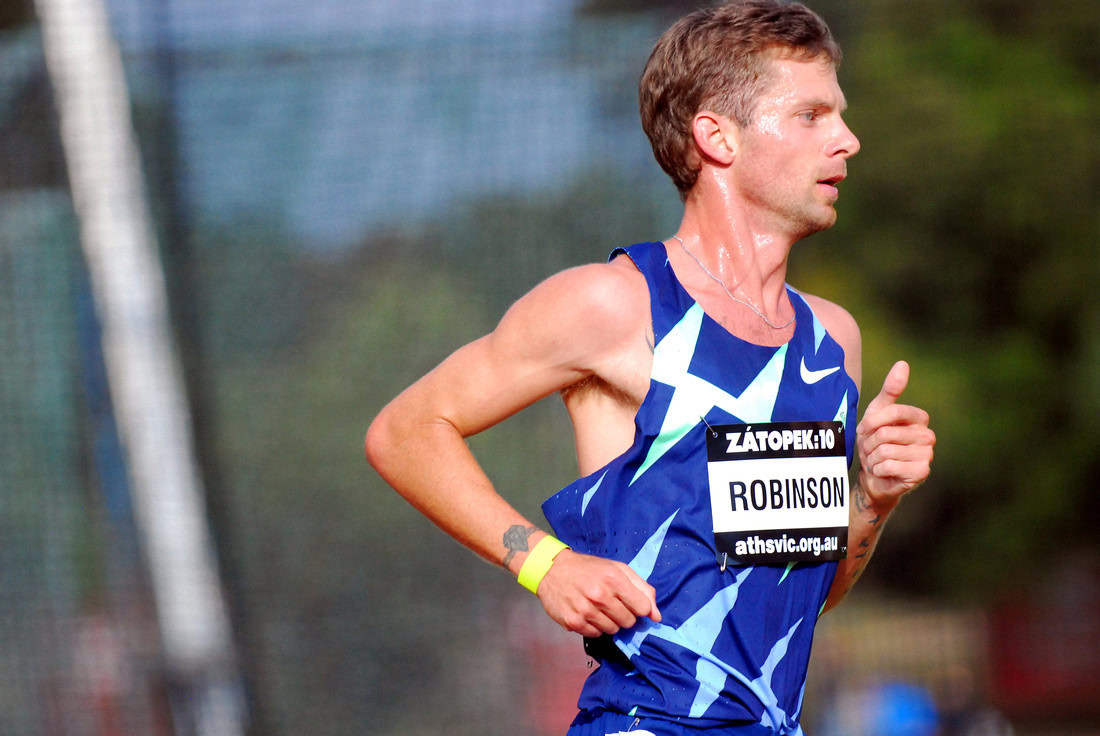
The Nic Bideau coached duo of Brett Robinson and Sinead Diver set new marks in Japan and Spain.
Running at the Fukuoka Marathon, Robinson ran 2:07:31 to take twenty seconds off the 1986 Boston Marathon winning time of Rob de Castella. Robinson finished fourth behind Ethiopian born Israeli athlete Maru Teferi, who won the race in 2:06:43.
Robinson covered the 42.195km distance in just a tick over three-minutes-per-kilometre, with metronomically consistent splits of 30:03 (10km), 60:06 (20km), 63:22 (halfway) and 1:30:08 (30km), before tiring only slightly in the closing stages (his 40km split was 2:00:47).
Brett Robinson breaks Rob de Castella’s Australian marathon NR with 2:07:31 for 4th at Fukuoka International Marathon. pic.twitter.com/AQVsuBSgjo— Japan Running News (@JRNHeadlines) December 4, 2022
“It’s such a great feeling. I’ve gone for this record a few times now, and it’s funny – I always talk about going for it before a race but I didn’t mention it to anyone this time around,” Robinson said after the race.
“I went about my own business and I finally got it. I knew I was capable of it.”
Robinson will now turn his attention to the 2023 World Cross Country Championships, being held in Bathurst on 18 February.
Achieving the record breaking performance in Fukuoka was poignant, as it is a happy stomping ground for Australian marathoners: Derek Clayton set a pioneering 2:09:37 world record on the course in 1967, while de Castella recorded the second fastest time of his career there (2:08:18) in his 1981 victory.

Hours later, in Valencia, Spain, Sinead Diver broke the women’s record by over a minute with her 11th place finish in 2:21:34. The performance bettered the 16-year-old Australian record held by Benita Willis at 2:22:36.
Remarkably, 45-year-old Diver is younger than Willis, but was only running occasionally for general fitness when Willis set the previous mark. Diver’s running career kicked off in earnest in 2010 and continues to go from strength-to-strength.
“I have wanted this for so long and I wasn’t sure if I was good enough to get it,” Diver said.
“I’ve had a few goes at it now, this was my third crack at it and every time I line up, it takes a lot. Things have to really fall into place so I’m beyond delighted that it’s happened.
“Benita (Willis) is Australia’s best runner of all time so it’s an honour to now have this record. I couldn’t be prouder today.”
Amane Beriso Shankule from Ethiopia took out the race in 2:14:58, the third fastest performance of all-time. In second, Letesenbet Gidey recorded the fastest ever debut marathon of 2:16:49. The race also had record depth, with the top seven in the field breaking 2 hours, 19 minutes. In the men’s race, Kenya’s Kelvin Kiptum recorded the fastest ever marathon debut with 2:01:53, just 44 seconds short of the world record set earlier this year by Eluid Kipchoge.
Top 5 Fastest Australian Marathoners – Men
- Brett Robinson – 2:07:31 – Fukuoka, 2022
- Rob de Castella – 2:07:51 – Boston, 1986*
- Steve Moneghetii – 2:08:16 – Berlin, 1990
- Derek Clayton – 2:08:34 – Antwerp, 1969
- Pat Carroll – 2:09:39 – Beppu-Oita, 1995
* The Boston Marathon is now considered ineligible for records under World Athletics Rules due to the start and finishing line being separated by more than 50% of the race distance. de Castella’s second fastest career time was 2:08:18 at Fukuoka in 1981.
Top 5 Fastest Australian Marathoners – Women
- Sinead Diver – 2:21:34 – Valencia, 2022
- Benita Willis – 2:22:36 – Chicago, 2006
- Lisa Ondieki – 2:23:51 – Osaka, 1988
- Lisa Weightman – 2:24:00 – Berlin, 2022
- Eloise Wellings – 2:25:10 – Nagoya, 2022
Latest posts:
- Kennedy claims national 100m title in 9.96
 Lachlan Kennedy has claimed his first national title in emphatic style, equaling his personal best in the best series of male 100m running ever seen at the Australian Championships. Kennedy backed up the 9.96 he clocked in yesterday’s heats in the cooler Saturday conditions, running the same time in the final with the aid of… Read more: Kennedy claims national 100m title in 9.96
 - Two Races, Two Realities: The Brutal Nature of Championship 1500m Racing
 Championship 1500m races are interesting things, as Cameron Myers and Jess Hull demonstrated in different ways on the second day of the 2026 Australian Championships in Sydney. If you’re the best, do you run from the front, or kick home with superior speed and strength? Cameron Myers chose the option of running everyone off their… Read more: Two Races, Two Realities: The Brutal Nature of Championship 1500m Racing
 - Scerri poised for Heptathlon breakthrough as Hincksman sets world record
 Mia Scerri’s ascent from promising talent to genuine national contender gathered momentum on day one of the heptathlon at the Australian Championships in Sydney, as the Victorian produced a career-defining opening to sit atop the standings. The 21-year-old, who was fourth at the 2024 World Juniors and 9th at last years World University Games, delivered… Read more: Scerri poised for Heptathlon breakthrough as Hincksman sets world record
 - Jess Hull Eyes Unprecedented Triple Crown in Sydney
 Australia’s top middle distance runner is challenging herself to achieve something never achieved before: winning the 800m, 1500m and 5000m at a single national championships. Hull, the Australian record holder over 800m (1:57.15) and 1500m (3:50.83), and former record holder over 5000m (14:43.80, now fifth on the Australian all-time list behind Rose Davies’s 14:31.45), will… Read more: Jess Hull Eyes Unprecedented Triple Crown in Sydney
 - Richardson’s glorious runs to Stawell Gift victory
 Victory from scratch happens rarely at the Stawell Gift, and certainly not in the fashion that Sha’Carri Richardson did on Easter Monday 2026 at Central Park. After sauntering through her heat victorious on Saturday in 13.82s* for the 12th fastest time of the day, there was the likelihood that the flamboyant American – the silver… Read more: Richardson’s glorious runs to Stawell Gift victory